What is the INFP personality type?
Idealists (INFPs) have strong values and ideals. They like to do work that aligns with these values. They focus on their own growth and the growth of others. They want to share their values and ideals with others and may be interested in helping humanity. They are usually flexible and relaxed, but they become firm when a valued belief is at risk. Idealists enjoy thinking and discussing ways to create positive changes in the future. They often feel energetic and commit fully to projects that matter to them.
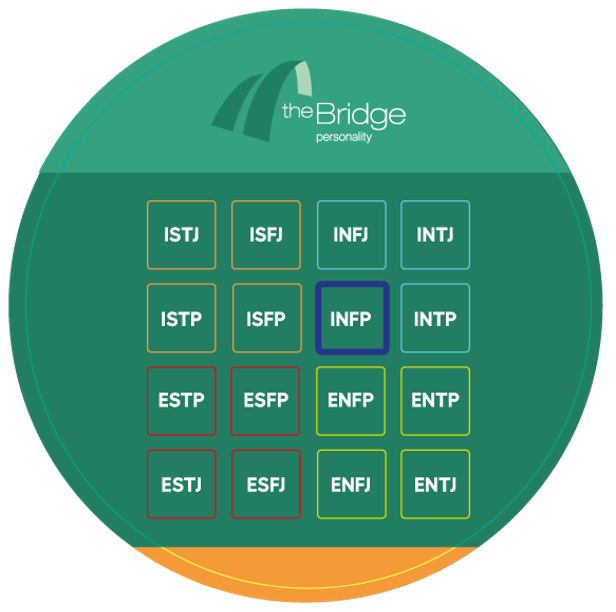
Preferences of the INFP:
How do others view INFPs?
INFPs easily adapt. They are flexible unless something important to them is threatened. They care a lot about other people, showing this more through actions (help) than words. They tend to observe and support rather than organize. They dislike dominating others. They sometimes tend to avoid decisions or underestimate their own achievements.
Others view INFPs as:
Pitfalls and development points of the INFP:
When INFPs find themselves in a place where they cannot use their characteristics and talents, they can sometimes:
INFP and Career
INFPs are flexible and adapt easily, but they don’t thrive in hectic, stressful, or highly hierarchical environments. Competitive workplaces can be frustrating for them; they prefer an environment where everyone feels valued and free to share ideas.
Although INFPs enjoy working independently, they sometimes need a little push to stay focused. In a team setting, they might be quiet and stay in the background, but they are often the ones colleagues turn to for help and advice. In their own calm and thoughtful way, they help keep the team together.
Best Careers for an INFP
INFPs want more than just a job that pays the bills; they seek work that inspires them and gives them a sense of fulfillment. They flourish in creative and people-oriented careers where they can help others or use their imagination. Suitable careers include:






















The Bridge Tests & Online Assessments
TestGroup is the official provider of the renowned Bridge tests and online assessments, which are high-quality, scientifically validated psychometric tools used globally. Developed in collaboration with universities around the world, these assessments predict workplace behavior through personality tests, cognitive ability evaluations, and career assessments. We assist organizations globally in using online assessments.






-
What is the INFP personality type according to The Bridge Personality?
-
The INFP type is known as an idealistic, values-driven type. INFPs want to contribute to something meaningful, help others grow and work in an environment that aligns with their principles.
-
How do INFPs behave in the workplace?
-
They are typically quiet, kind, reflective and sincere. INFPs are loyal, original, creative, flexible and supportive. Colleagues often describe them as helpful, adaptable and humorous.
-
What are common development points for INFPs?
-
If they cannot use their strengths, they may overlook logical systems, struggle with complex information, work less accurately or have difficulty finishing tasks.
-
Which careers are a good fit for INFPs?
-
They thrive in roles with creativity, autonomy and personal meaning, such as consulting, communications, teaching, social work, psychology, writing, journalism or creative professions.
-
How does The Bridge Personality differ from the MBTI or 16Personalities?
-
- The Bridge Personality uses a scientifically stronger foundation by combining Jung Types with Big Five insights and the 4-colour model.
- The test includes advanced psychometrics, such as adaptive items and techniques that detect socially desirable answering.
- It is designed specifically for HR, recruitment, leadership development and teams.
- Compared to MBTI and 16Personalities, it provides more detailed and reliable information because it measures both personality dimensions and the 16 types, instead of only assigning one fixed type.
-
Can organisations use the INFP insight in hiring or team development?
-
Yes. It shows how someone with INFP preferences typically works, communicates and contributes. It supports decisions in selection, coaching and team design. It should always be combined with other information such as competencies and experience.
-
Is the INFP type fixed?
-
No. It reflects preferences, not fixed behaviour. People can grow, adapt and show different behaviour depending on the context. The Bridge Personality combines type and trait information, making this flexibility visible
-
How can organisations apply the INFP profile?
-
- Match the job environment to what motivates INFPs, such as meaningful work and creativity.
- In teams, place them where reflection, empathy and innovation are needed.
- Support their development by strengthening structure, planning and decision-making.
- Use team analyses to understand how INFPs complement other types.
-
Do clients receive a free debriefing of the results?
-
Yes. Organisations can request a free debriefing of the results with a TestGroup consultant. This can be done by phone or via an online meeting. It helps you understand the results and apply them correctly.
-
Is a free training session included with an annual subscription?
-
Yes. An annual subscription includes a free training session. During this session you learn how to use the assessments, set them up for candidates, interpret reports and apply the results in your organisation.
Online Assessment Tips