What is the ISTP personality type?
ISTPs carefully observe their surroundings and respond promptly to challenges. They aim to identify the essence of a problem to solve it effectively and with minimal effort. Their curiosity lies in understanding the mechanics behind things, but they find abstract theories dull unless applicable. They frequently assume the role of a problem solver. Calm and reserved, they are genuinely interested in the workings of the world around them.
The 16 Personality Test highlights ISTPs for their hands-on problem-solving skills. Businesses apply this test to place ISTPs in technical and independent roles that require quick thinking and adaptability.
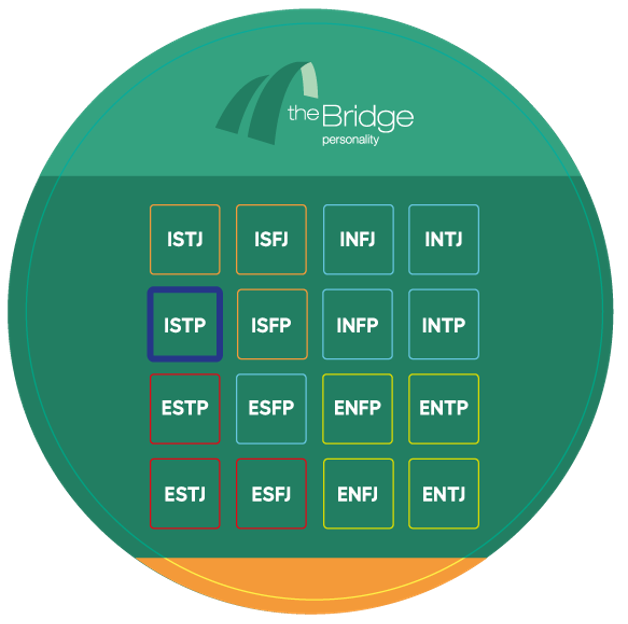
Preferences of ISTPs:
How do others view ISTPs?
ISTPs believe that all people should be treated equally and tolerate a wide range of behavioral styles. They have clear basic principles and can be determined to defend them. Problem Solvers can easily adapt their behavior if it helps to solve a problem or situation. Others may find this behavior difficult to understand.
Others view ISTPs as:
Pitfalls and development points of the ISTP:
When ISTPs find themselves in a place where they cannot use their characteristics and talents, they can:
ISTP and Career
ISTPs feel most comfortable in practical and technical environments where they can apply their analytical skills and problem-solving abilities. They enjoy independence and prefer hands-on work on challenging projects.
Working with an ISTP
ISTPs dislike rigid rules and bureaucracy in the workplace. They appreciate flexibility and variety, working best at their own pace and in their own way. Give them the freedom to find solutions independently, and you’ll see how efficiently and intelligently they operate.
Best Careers for an ISTP
ISTPs thrive in technical and hands-on professions where they can combine problem-solving with action. They enjoy developing their skills and prefer work with plenty of variety. Suitable careers for ISTPs include:




















The Bridge Tests & Online Assessments
TestGroup is the official provider of the renowned Bridge tests and online assessments, which are high-quality, scientifically validated psychometric tools used globally. Developed in collaboration with universities around the world, these assessments predict workplace behavior through personality tests, cognitive ability evaluations, and career assessments. We assist organizations globally in using online assessments.






-
What is the ISTP personality type in The Bridge Personality’s framework?
-
In The Bridge Personality’s framework, ISTP types are practical, analytical and calm problem-solvers. They observe carefully, act quickly when needed and prefer clear, efficient solutions. They enjoy understanding how things work and focus on direct, hands-on results.
-
What are typical strengths of an ISTP?
-
- Strong analytical and technical insight
- Calm under pressure and able to respond quickly
- Independent, direct and action-oriented
- Practical and realistic in decision-making
- Flexible and able to adapt to sudden changes ISTPs often bring clarity and structure to complex or fast-moving situations.
-
What are common development points for ISTPs?
-
- They may overlook emotional dynamics in a team.
- They can appear detached when situations require empathy.
- They sometimes focus too narrowly on the immediate solution.
- They lose interest when tasks feel repetitive or lack practical relevance.
-
Which roles or environments suit ISTPs best?
-
ISTPs typically thrive in technical, analytical or hands-on environments. Roles in engineering, IT, mechanics, research, operations, aviation, quality control or forensic work often suit them well. They perform best when they have autonomy and clear problem-solving tasks.
-
How does The Bridge Personality’s interpretation of ISTP differ from MBTI?
-
- MBTI places strong emphasis on preferences and cognitive functions (I/E, S/N, T/F, J/P).
- MBTI is mainly used for self-insight and team development.
- The Bridge Personality focuses more on observable workplace behaviour, competencies and job-fit.
- It provides a practical, business-oriented interpretation of the ISTP style, not just a preference-based description.
-
How does the ISTP description compare with 16Personalities?
-
- 16Personalities uses the label “Virtuoso” and highlights exploration, creativity and spontaneity.
- It includes subtypes like ISTP-A and ISTP-T to show differences in confidence levels.
- 16Personalities is designed for general personal insight and lifestyle reflection.
- The Bridge Personality focuses on professional behaviour, team interaction, strengths, development points and organisational relevance.
-
Why might organisations prefer The Bridge Personality’s ISTP profile over MBTI or 16Personalities?
-
- It links the ISTP style directly to competencies, workplace behaviour and suitability for specific roles.
- It is part of a broader assessment system combining personality, ability and career motivation.
- The descriptions are practical and designed for recruitment, development and team decision-making.
- It focuses on measurable behaviour rather than on broad lifestyle or preference-based descriptions.
-
Is an ISTP label a full description of a person?
-
No. A personality type is an indicator, not a complete portrait. People with an ISTP profile often share certain tendencies, but individual experience, skills and job context play an equally important role. Personality results should always be combined with interviews, ability testing and job-related information.
-
Can ISTPs succeed outside technical or hands-on fields?
-
Absolutely. Many ISTPs succeed in project management, operations, leadership roles, consulting or crisis-oriented work—especially where clear analysis, quick decision-making and independence are valuable.
Online Assessment Tips