What is the auditor (observer) in the 4 color personality test?
The auditor in the 4 colour test is a personality type that focuses on accuracy, analysis and careful observation; this profile is also often called the observer. An auditor pays close attention to details, checks facts and prefers to make decisions based on data rather than assumptions. Typical characteristics of the auditor or observer are precision, critical thinking, structured working and a strong sense of quality. In organizations, this personality type plays an important role in areas such as finance, quality control, compliance and research, because the auditor helps detect risks, improve processes and ensure reliable results.
4 color personality type: The Auditor
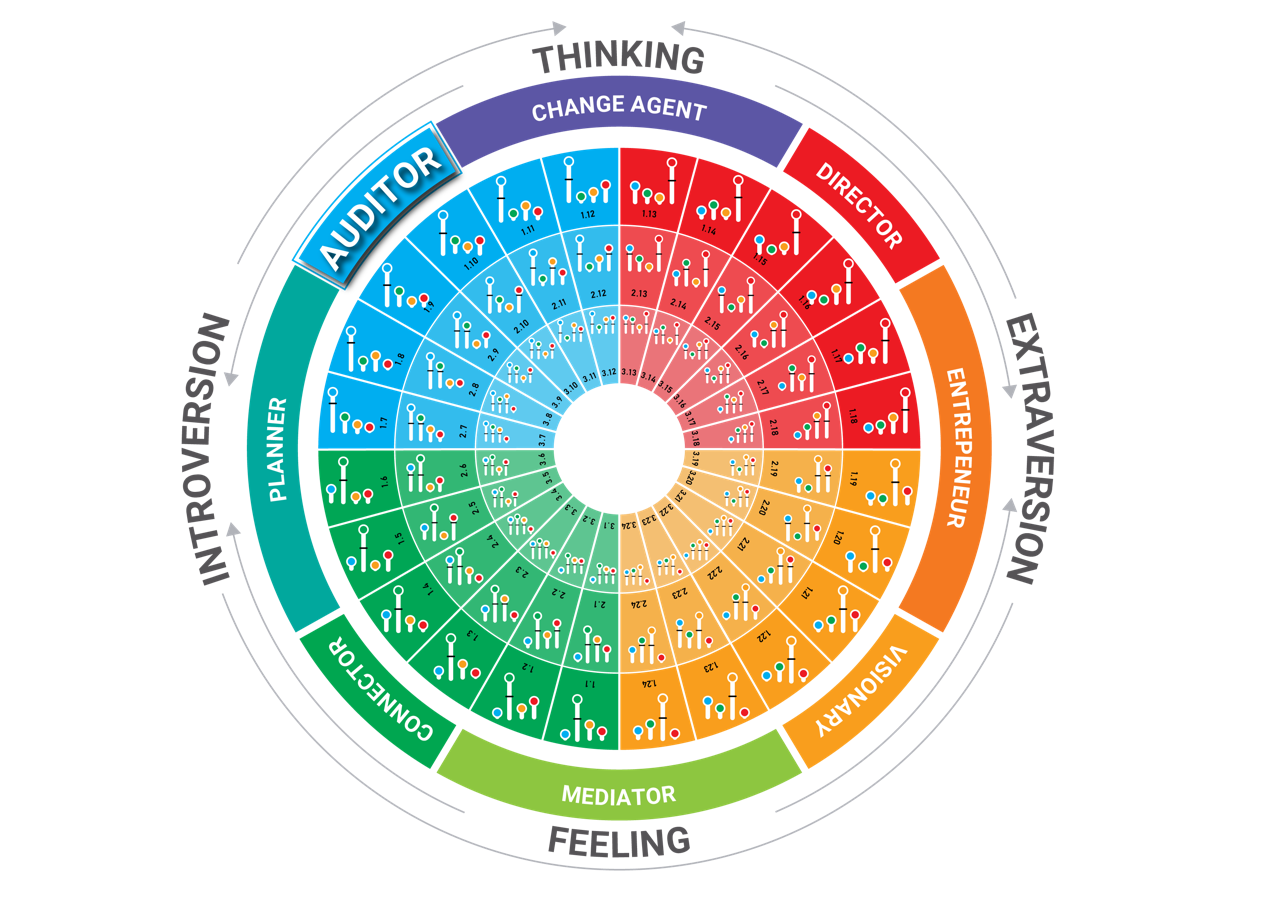
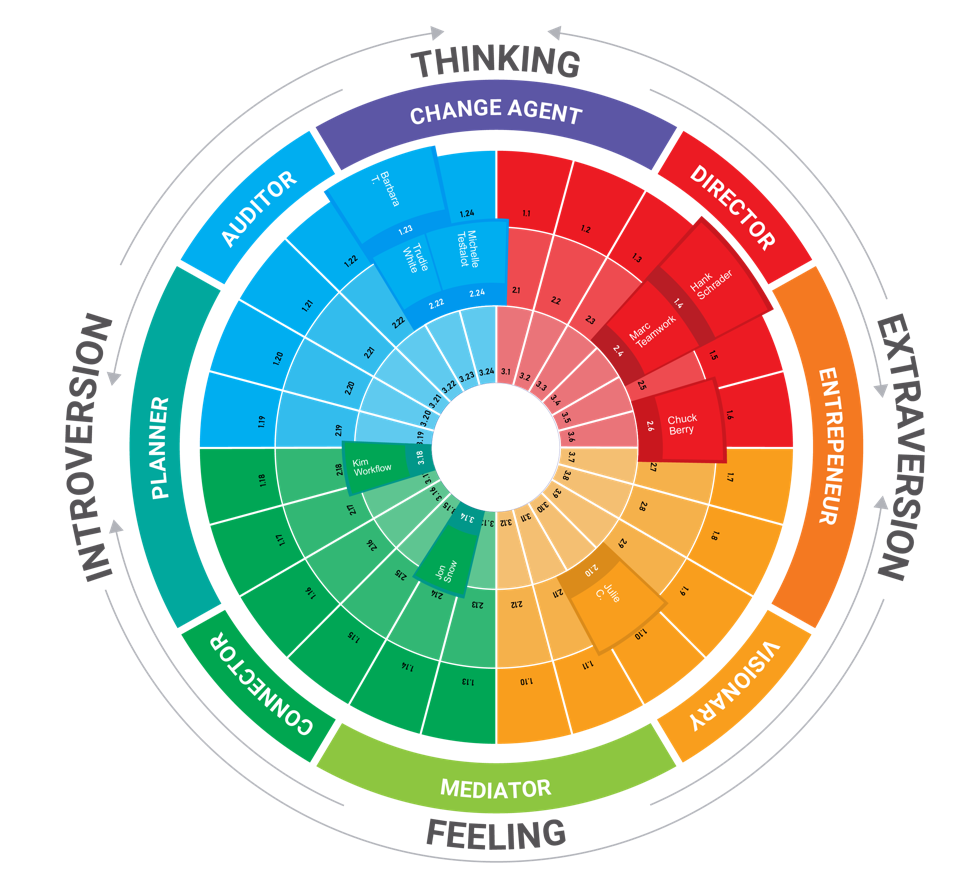
The 4-color personality test divides personalities into four primary colors: Red, Blue, Green, and Yellow, each representing key traits like logic, creativity, empathy, and decisiveness. These colors form the foundation of eight distinct personality types, blending traits from two adjacent colors on the personality wheel.
The 8 types in the 4 color personality test
The 8 personality types are: The Auditor (focused, detail-oriented, and analytical), The Planner (organized and methodical), The Connector (empathetic and relationship-driven), The Mediator (calm and conflict-averse), The Visionary (imaginative and innovative), The Entrepreneur (dynamic and risk-taking), The Director(decisive and goal-oriented), and The Change Agent(adaptive and forward-thinking). The wheel shows how the traits from two neighboring colors combine, creating unique types that balance and blend the characteristics of both colors. This model helps individuals and teams better understand behavior, communication styles, and collaboration.
The Auditor personality type
The Auditor personality type, linked to the Blue quadrant of the 4-color personality test, represents individuals who are precise, logical, and methodical. These individuals excel in structured environments and bring a sense of order and accuracy to their work. Auditors are invaluable in roles requiring meticulous attention to detail, such as finance, research, law, or quality control.
Key characteristics of Auditors
Auditors are disciplined, cautious, and thorough. They have highly developed critical thinking skills and base their actions on factual data. They prefer to gather all the information and prepare carefully to avoid errors, which makes them reliable and trusted in their roles.
Auditors also combine intuition with logic to read situations effectively. However, they may hesitate to make decisions, fearing ridicule or abrupt change. They are often reticent about expressing emotions and can appear reserved or even distant to others.
How Auditors add value to organizations
Auditors are essential for adding structure and clarity to teams and organizations. They excel in testing, clarifying, and evaluating processes, ensuring everything meets the highest standards. Their skills are particularly valuable when improving communication within teams. By focusing on communication with a 4-color personality test, organizations can better understand personality types like the Auditor and enhance collaboration. Auditors thrive in environments where accuracy and predictability are key and contribute by:
However, Auditors may overuse analysis, becoming bogged down in details or hesitant to act. Under pressure, they can become overly worried, inflexible, or stuck in past processes.
Challenges that Auditors face
While Auditors bring valuable precision and discipline, their perfectionism can sometimes hold them back. They may avoid acknowledging mistakes and over-research to justify their position. Their preference for predictability and their cautious nature can also lead to a fear of abrupt change or conflict.
To be more effective, Auditors can benefit from:
Improve teamwork with the DIY Workshop Kit
The Team Workshop Do-It-Yourself Kit is an easy way to help teams understand and work better together. It introduces the 8 personality types from the 4-color model, like The Auditor, The Planner, and The Change Agent. By exploring these types, team members learn more about themselves and each other, making collaboration smoother and more effective. The kit is simple to use and ideal for team leaders or HR professionals.
The Auditor’s role in teamwork
In teams, Auditors excel at ensuring tasks are completed accurately and processes are followed thoroughly. They provide stability, create detailed plans, and double-check everything to avoid errors.
However, their reserved nature can make them seem unresponsive or uncaring to team members who rely on emotional connection. It’s important to recognize their contribution to the team’s success, even if they don’t openly seek acknowledgment.
How Auditors handle stress
Under stress, Auditors may focus excessively on details and become overly critical of themselves and others. They may hesitate to make decisions, fearing they lack enough information or might make a mistake. Their worry about outcomes, reputation, or job security can increase, leading them to withdraw or become unyielding in their approach.
Common stress triggers for Auditors:
Tips for supporting an Auditor
To help Auditors thrive, organizations and team members can:
Auditors and the Jungian connection
Auditors align with Jung’s Thinking type, which focuses on empirical data and logical reasoning. They excel in observing and interpreting situations, using both intuition and facts effectively. While they prefer working independently, they bring immense value to teams by balancing creativity with realism.
The Auditor personality is a cornerstone of many successful organizations. Their ability to analyze, clarify, and ensure accuracy makes them indispensable in high-stakes roles. By fostering flexibility and emotional understanding, Auditors can further amplify their contributions to any team or project.
Want to learn how the 4-color personality test can help your organization? Read our detailed guide here.
The 4 color team report for better collaboration
The 4 color team teport shows your team’s strengths and personality traits. It helps improve communication and teamwork, making your team more effective. Ideal for leaders and HR professionals.





















The Bridge Tests & Online Assessments
TestGroup is the official provider of the renowned Bridge tests and online assessments, which are high-quality, scientifically validated psychometric tools used globally. Developed in collaboration with universities around the world, these assessments predict workplace behavior through personality tests, cognitive ability evaluations, and career assessments. We assist organizations globally in using online assessments.






-
What is the 4-color personality type The Auditor?
-
The Auditor is the blue 4-color personality type. People with this preference are analytical, precise and careful. They value structure, facts and clear agreements, and they like to deliver high quality work without mistakes.
-
Which color is dominant in The Auditor profile?
-
The Auditor is mainly blue. That means focus on logic, preparation, accuracy and control. This type prefers to think before acting and wants to fully understand information before making a decision.
-
What are typical strengths of The Auditor?
-
Auditors bring quality, depth and reliability. They read the details, ask critical questions, guard procedures and spot risks early. They are strong in compliance, analysis, quality control, finance, legal work, research and any role where accuracy matters.
-
What are possible pitfalls of The Auditor?
-
Because they like certainty and details, Auditors can come across as critical, distant or slow in decision making. They may spend too long checking information or see too many risks. In teams, it helps if others appreciate their thoroughness and they in turn remain open to pragmatism and flexibility.
-
How does The Auditor behave in a team?
-
In a team, The Auditor is the person who structures, checks, documents and improves. They ensure that promises are realistic, decisions are well-founded, and outcomes meet the required standard. They feel comfortable when expectations are clear and there is room for thorough, in-depth analysis.
-
How does The Auditor compare to Insights Discovery?
-
In Insights Discovery, The Auditor most closely corresponds with the Observer: precise, cautious, disciplined and conscientious. It also aligns strongly with a pronounced Cool Blue preference: careful, structured, analytical and fact-focused. Where Insights uses colors as a clear, accessible language for behavior, the 4-color personality test from TestGroup connects these color preferences directly to a scientifically grounded personality profile and concrete leadership and performance competencies.
-
How does The Auditor relate to other 4-color personality types?
-
Within the 4-color model, The Auditor is the opposite of fast, impulsive red-yellow behavior. They complement more direct, intuitive profiles by adding nuance, control and structure. In a balanced team, the combination of The Auditor with types such as the Visionary, Entrepreneur or Director is often very powerful.
-
:How does The Auditor relate to Management Drives?
-
The Auditor shows parallels with Management Drives profiles that value structure, control, quality and reliability. Think of drives focused on rules, analysis and responsibility. Just like these profiles, The Auditor prefers clarity, preparation and well-founded decisions. The difference is that the 4-color personality test from TestGroup links this preference not only to motivation, but also to a validated personality profile and concrete competencies that are directly applicable in selection and leadership development.
-
Is The Auditor a "better" type than others?
-
No. There is no “best” color or best type. The Auditor adds value in situations where accuracy, reliability and careful decision-making are crucial. Other types bring energy, speed, connection or change. What matters most is finding the right match between the person, the role and the context.
-
For which roles is The Auditor often a good fit?
-
Typical roles include finance, control, auditing, legal, data analysis, risk management, engineering, policy, and quality management, as well as any position where regulations, details and accuracy are essential. In management roles, Auditors bring thoroughness, content-driven leadership and stability.
-
How can organizations use the 4-color personality test for The Auditor type?
-
With the 4-color personality test (The Bridge Personality), organizations can identify whether a candidate has a strong Auditor profile, how this combines with other colors and how well this fits a specific role or team. The results provide clear input for selection, onboarding, collaboration and targeted development.
Online Assessment Tips