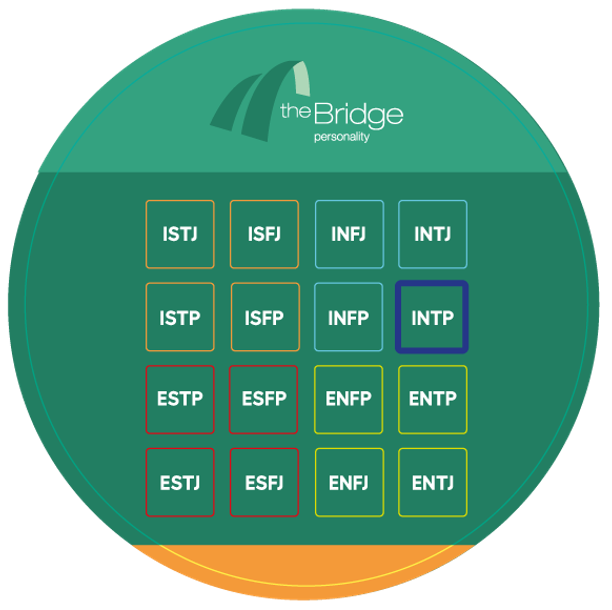
What is the INTP Personality Type?
Strategists (INTPs) are independent problem solvers. They are good at analyzing ideas or situations in a clear and objective way. They prefer to work alone when tackling problems. Strategists get enthusiastic about theories and ideas, and they want to make these theories easy to understand. They highly value knowledge, competence, and logic. INTPs push themselves and others to find new, logical solutions.
The 16 Personality Test assists companies in identifying INTPs by recognizing their curiosity and logical thinking. Businesses leverage these insights to position INTPs in roles related to research, innovation, and strategy.
Preferences of INTPs:
How do others view INTPs?
In their interactions with others, INTPs are often quiet and reserved. They talk a lot about subjects they know much about or are interested in. At work, they are more interested in devising solutions than in the practical implementation of solutions. Strategists prefer precise explanations without too much superfluous information. They value exact truth, but they can sometimes explain it so complexly that others have difficulty understanding them.
Others view INTPs as:
Pitfalls and development points of the INTP:
When INTPs find themselves in a place where they cannot use their characteristics and talents, they can sometimes:
INTP and Career
If you have an INTP colleague, you’re working with an analytical and innovative thinker. INTPs don’t typically enjoy standard workplace cultures with team-building activities, check-in meetings, or small talk, but that doesn’t mean they aren’t valuable team members—far from it! They are driven by curiosity and a deep desire to solve complex problems. Their ability to recognize patterns and develop intricate ideas makes them indispensable in strategic and technical roles.
Working with an INTP
INTPs think big and approach problems in original ways, which benefits everyone around them. Give them the space to develop their ideas and involve them in brainstorming sessions—this is where their most innovative solutions emerge. Are you an INTP yourself? Remember that collaborating with colleagues isn’t just useful, but also inspiring. Exchanging knowledge often leads to the best ideas.
Best Careers for an INTP
INTPs thrive in environments where they have the freedom to experiment, develop new theories, and solve analytical problems. They crave intellectual challenge and need a career that keeps them engaged. Suitable careers for INTPs include:






















The Bridge Tests & Online Assessments
TestGroup is the official provider of the renowned Bridge tests and online assessments, which are high-quality, scientifically validated psychometric tools used globally. Developed in collaboration with universities around the world, these assessments predict workplace behavior through personality tests, cognitive ability evaluations, and career assessments. We assist organizations globally in using online assessments.






-
How does INTP in 16Personalities differ from other descriptions?
-
16Personalities uses the same four-letter codes as the MBTI, but adds its own names, visuals and simplified descriptions. It is designed mainly for personal insight, not for selection or professional use.
-
How is The Bridge Personality different from MBTI and 16Personalities?
-
The Bridge Personality is not the MBTI. It offers a more complete and scientifically grounded approach by combining Big Five traits, the 16 Jung Types and the 4-Colour model. Instead of placing someone into only one type (like INTP), The Bridge Personality shows trait-scores on continuous scales and adds explanations in multiple frameworks.
-
Does The Bridge Personality also provide the INTP type?
-
Yes. The Bridge Personality includes the 16 Jung Types, so participants can see whether they align with the INTP type. However, the outcome is supported by Big Five scores and colour results, which makes the interpretation more detailed and reliable.
-
Why is The Bridge Personality more suitable for organisations?
-
Because it is built for professional contexts, with strong scientific foundations, competency scores and clear behavioural indicators. This makes it more useful for recruitment, talent development and team coaching than MBTI and 16Personalities.
-
What are typical strengths of an INTP type in the workplace?
-
INTP types often excel in analytical thinking, independent problem-solving, creativity and objective decision-making. They are strong in understanding systems, structures and new concepts.
-
What challenges can INTP types experience?
-
They may need support with structure, deadlines and practical details. INTP types sometimes spend too much time analysing options instead of making a quick decision.
-
How can managers work effectively with an INTP type?
-
Give them complex problems to solve, provide space for independent thinking and avoid unnecessary rules. Clear expectations and regular check-ins help keep projects on track.
-
Is an INTP type common in technical or analytical roles?
-
Yes. INTP types often choose careers where logic, structure and innovation play a major role, such as engineering, data analysis, programming, consultancy and scientific research.
-
What is the INTP personality type?
-
The INTP personality type describes people who are analytical, logical and independent in their thinking. They enjoy exploring complex ideas, spotting patterns and developing original solutions. This type is often linked to roles in research, analysis, IT and technical fields.
-
Does the INTP type come from the MBTI?
-
Yes. INTP is one of the 16 types from the MBTI model, based on Jung’s theory. Many people recognise the INTP profile because of this typology.
Online Assessment Tips