Big Five personality test: Emotional Stability
The Bridge Personality has been the most widely used Big Five personality test by companies and organizations in many countries worldwide for 15 years. This test, based on the Big Five theory, is generally considered the ultimate personality test for recruitment and selection purposes. The theory emphasizes that personality is composed of five primary traits, known as the Big Five, which together form the five personality factors.
This Big Five personality test can be ordered individually for each candidate or as part of a cost-effective assessment subscription, allowing you to manage the test yourself.
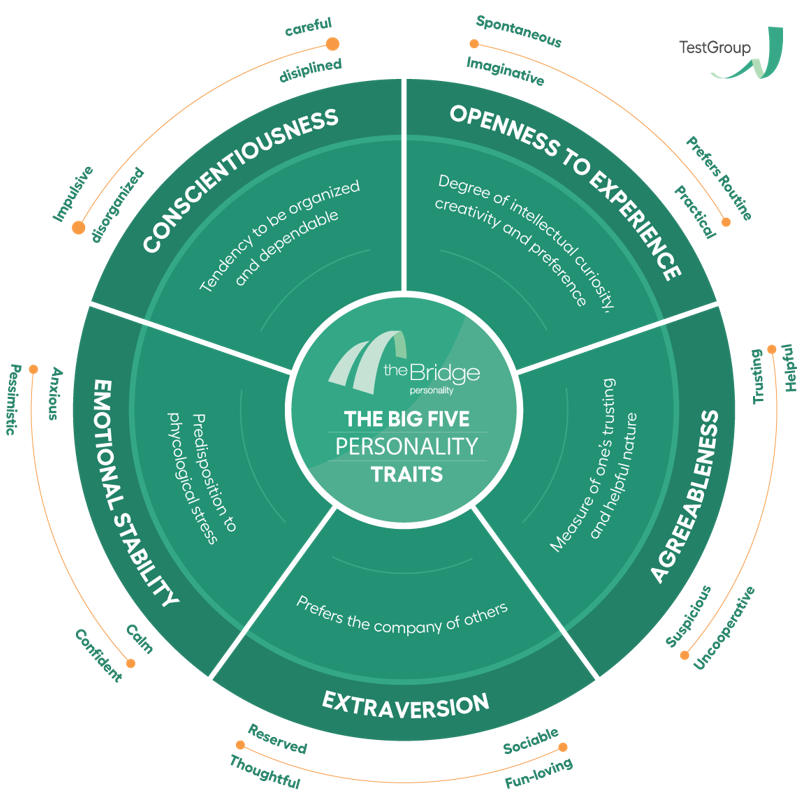
The scientifically constructed Big Five personality test measures the five fundamental dimensions of personality: Openness to Experience, Conscientiousness, Extraversion, Agreeableness, and Emotional Stability, often referred to as the Big Five. The five-factor model, also known as the OCEAN model, is widely used in selecting the right candidates due to its scientific validity.
What is The Big Five personality trait: Emotional Stability?
Emotional Stability, the opposite of the ‘Neuroticism’ trait in the Big Five personality test, gauges a person's ability to remain calm, composed, and emotionally consistent. High scorers in Emotional Stability (meaning low in Neuroticism) typically maintain their calm during stressful situations, experience fewer mood swings, and exhibit less negative emotionality. Conversely, those with low Emotional Stability (high Neuroticism) are more prone to emotional outbursts and struggle to manage their emotions in challenging times. Being highly emotionally stable is associated with greater life and job satisfaction and reduced stress levels. People with this trait are also more adept at handling workplace pressures and adapting to rapid changes.
The science of Emotional Stability
The Big Five personality trait of Emotional Stability, often framed as its inverse, Neuroticism, has been extensively studied within the field of psychology. This trait assesses an individual's tendency towards emotional regulation, calmness, and resilience in the face of stress. Seminal research by Costa and McCrae with the development of the NEO Personality Inventory significantly advanced the understanding of Emotional Stability, highlighting its role in psychological well-being and its inverse relationship with neurotic tendencies (Costa & McCrae, 1992).
Eysenck’s earlier theories, particularly his dimensional model of personality, laid the groundwork for this understanding, linking neuroticism with emotional instability and vulnerability to psychological distress (Eysenck, 1967). Subsequent research has consistently found that high Emotional Stability (low Neuroticism) correlates with better mental health, lower stress levels, and greater life satisfaction (Digman, 1990; John, Naumann, & Soto, 2008). This trait has been a focus in studies exploring the genetic and neurobiological underpinnings of personality, further elucidating its basis in individual differences (DeYoung, 2010; Canli, 2008). Collectively, this research underscores Emotional Stability as a critical dimension of personality, influencing an individual's overall psychological health and response to stress.
Which Big Five personality test facets measure Emotional Stability?
The Big Five personality test measures 34 personality facets that are linked to the Big Five personality traits. The facets that measure Emotional Stability are:





















The Bridge Tests & Online Assessments
TestGroup is the official provider of the renowned Bridge tests and online assessments, which are high-quality, scientifically validated psychometric tools used globally. Developed in collaboration with universities around the world, these assessments predict workplace behavior through personality tests, cognitive ability evaluations, and career assessments. We assist organizations globally in using online assessments.






-
What is the Big Five personality trait Emotional Stability (Neuroticism)?
-
Emotional Stability, sometimes described as the opposite of Neuroticism, is one of the five traits in the Big Five personality model. It reflects how calm, resilient and emotionally consistent someone is. People high in Emotional Stability (low in Neuroticism) tend to stay composed under pressure, experience fewer mood swings and recover more quickly from setbacks.
-
Why is Emotional Stability important at work?
-
Emotional Stability is strongly linked to how someone deals with stress, change and setbacks at work. Employees with higher Emotional Stability usually:
• cope better with work pressure and deadlines
• remain calm in conflicts or crisis situations
• show more consistent behaviour over time
This makes Emotional Stability an important predictor of long term performance, teamwork and leadership potential.
-
How does The Bridge Personality measure Emotional Stability (Neuroticism)?
-
The Bridge Personality, TestGroup’s Big Five personality test, measures Emotional Stability using several underlying facets. These facets include how stress resistant, positive and self confident someone is. Together they provide a detailed picture of how a person regulates emotions and responds to pressure in everyday work situations.
-
What does a high score on Emotional Stability mean?
-
A high score on Emotional Stability (low Neuroticism) means that someone is generally calm, relaxed and emotionally balanced. This person:
• can handle setbacks without overreacting
• feels less anxious or insecure in new situations
• is less sensitive to stress at work
In many roles, especially in leadership and customer facing jobs, a higher level of Emotional Stability is an advantage.
-
What does a low score on Emotional Stability (high Neuroticism) mean?
-
A lower score on Emotional Stability indicates that someone is more sensitive to stress, criticism and uncertainty. This person may:
• worry more about mistakes or future events
• experience stronger mood swings
• need more support and predictability at work
This is not “good” or “bad” in itself, but it does mean that the work environment and style of management should be extra supportive and clear.
-
How can HR professionals use Emotional Stability in selection?
-
HR professionals and recruiters use Emotional Stability as one of the key indicators when they select candidates for roles with high pressure, responsibility or frequent change. By combining the Emotional Stability score with other Big Five traits and competencies, they can:
• assess how someone will react in demanding situations
• reduce the risk of stress related underperformance
• make better decisions about job fit and team fit
-
Is Emotional Stability the same as mental health?
-
No. Emotional Stability is a personality trait, not a diagnosis. A lower score does not mean that someone has a psychological disorder, and a high score does not guarantee perfect mental health. It simply shows how someone typically responds emotionally to everyday challenges and stress at work.
-
Can Emotional Stability change over time?
-
Personality traits are relatively stable, but they can change slowly over the years. Coaching, feedback and work experience can help people become more resilient and develop healthier coping strategies. In practice, this means that Emotional Stability can improve when someone learns to handle stress more effectively and builds confidence in their role.
-
How does Emotional Stability relate to the other Big Five traits?
-
Emotional Stability is one of the five core traits in the Big Five model, alongside Openness, Conscientiousness, Extraversion and Agreeableness. Together these traits give a broad picture of how someone thinks, feels and behaves at work. Emotional Stability adds the dimension of how someone deals with pressure and emotions, which completes the overall personality profile.
-
Why use a Big Five test from TestGroup to measure Emotional Stability?
-
TestGroup’s Big Five personality test, The Bridge Personality, is scientifically developed and widely used by organizations worldwide. It measures Emotional Stability (Neuroticism) and the other four Big Five traits in a reliable way, providing clear reports for recruitment, talent development and coaching. This helps HR professionals and managers make well founded decisions about people and roles.
Online Assessment Tips