The Bridge Personality: the candidate book
View and download this digital book
The Bridge Personality
The candidate book
ENGLISH EDITION
TESTGROUP
personality
The Bridge Personality is a modern personality test that measures the Big
Five personality traits, the 16 Jung Types and the 4 personality colors in
one online assessment.
It is one of the most widely used personality assessments for recruitment,
employee development and coaching. The Jung Type model used in The
Bridge Personality has also been independently evaluated as one of the
best methods for measuring the 16 Jung Types.
The Candidate Book helps you gain a deeper understanding of The
Bridge Personality and its results. It explains how the assessment measu-
res personality, preferences and competencies, and provides detailed
descriptions of all 16 Jung Types. You will also learn how Jung Types are
determined and how the results can be applied in practice for personal
and professional development.
Do you want to read more about the Bridge Personality?
Try this book:
The Bridge Personality: Use in teams
The Bridge Personality: the book for sales
978 94 90571 01 6
Product code: BPTC012
ENGLISH
This product is sold in packs
of 10
The Bridge Personality
The candidate book
A manual for the interpretation of your Bridge Personality results. ®
Third Edition
ENGLISH EDITION
TestGroup
Copyright © 2007, 2008, 2016, 2026 Testgroep BV. All rights reserved.
Published and distributed with the permission of the publisher, Testgroep BV, Herengracht 282, 1016BX, Amsterdam.
Third edition published in the Netherlands. Nothing from this edition may be reproduced, stored in a database, or made public
in any form or by any means, electronic or mechanical, including photocopying or recording, without prior written permission
from the publisher.
The Bridge Personality is a registered trademark of Testgroep BV
The Bridge is a registered trademark of Testgroep BV
TestGroup is a registered trademark of Testgroep BV
TestGroup
Herengracht 282
1016 BX Amsterdam
info@testgroup.eu
Tel: +31202621630
www.testgroup.com
ISBN: 978 94 90571 01 6
Introduction 4
The Big Five: 34 dimensions 4
The Type Theory of Jung: 16 Types 4
8 Competencies 4
The feedback interview 5
STAR method 5
Strengths and Pitfalls 6
Core Quadrants 6
Scores & Answer behaviour 7
Stenscores 7
Acquiescence 7
Social desirability 7
Correspondence Normative-Ipsative 7
Normative-ipsative split 8
Bridge Dimensions 9
Contact & Management 10
Influence & Disposition 11
Drive & Implementation 12
Social contact & Resilience 13
Flexibility & Perception 14
Opinion & Evaluation 15
What are Jung Types? 16
How do you determine your Jung Type 17
Step 1: Reported Jung Type 17
Step 2: Self-assessed Jung Type 17
The 4 Jung Dimensions 18
The Jung Type Table 20
ISTJ - Realist 21
ISFJ - Carer 22
ESTP - Doer 22
ESFP - Performer 24
INTJ -Scholar 25
INFJ - Advisor 26
ENTP - Innovator 27
ENFP - Inspirer 28
ISTP - Solver 29
INTP - Strategist 30
ESTJ - Decision-maker 31
ENTJ - Leader 32
ISFP - Peace maker 33
INFP - Idealist 34
ESFJ - Service provider 35
ENFJ - Coach 36
To remember about Jung Types 37
Using the Jung Types
Jung Types at work 38
Jung Types and professions 39
Bridge Competencies 40
The 4-Colour wheel 41
The 4-Colour model 42
Personality Colour: blue 43
Personality Colour: red 44
Personality Colour: yellow 45
Personality Colour: green 46
Team Report 47
Team report - Team Type 48
Team Report - Exercise 49
Team Report - Team Wheel 50
Teams: Colours 51
Content
Introduction
any organisations use personality tests for
selection or development of their employees.
There are two kinds of personality tests that are
used very often. Tests that are based on the ‘Big
Five’ and tests that are based on the Jung’s Type
Theory.
Big Five personality tests are often used for the
selection of personnel. Personality questionnaires
that are based on Jung Types are mostly used for
development of employees. The Bridge Personality
is the only personality measure in the world that
measures both the Big Five and the type theory of
Jung.
Because of this dual measurement, it is possible to
use the Bridge Personality for selection as well as
for personnel development. The Bridge Personality
measures 34 personality dimensions, identifies your
Jung Type, and provides scores on 8 job-related
competencies.
The Big Five: 34 Dimensions
According to the Big Five theory, differences in
personality can be described using five broad fac-
tors. This scientifically validated model is widely
used in personnel selection and other situations
where predicting future workplace behavior with a
personality test is important.
The Type Theory of Jung: 16
Types
The theory of Carl Gustav Jung was developed to
explain the natural differences between people.
Jung believed that everyone has inborn preferences
that influence how they think, communicate, make
decisions, and interact with others. By identifying
these preferences, individuals can determine their
Jung Type and gain a better understanding of their
natural strengths and working style. Because it
focuses on self-awareness and personal preferences
rather than abilities, Jung’s theory is particularly
valuable for personal and professional develop-
ment.
8 Competencies
Many of the 34 personality dimensions can be
linked to competencies that are commonly used
in competency frameworks within organisations.
A competency consists of more than personality
alone; it also includes motivation, skills, and cog-
nitive ability. The competencies used in The Bridge
Personality (shown on the last page of the report)
are based on combinations of these personality
dimensions and provide insight into work-related
behaviour and potential.
When you study your Bridge Personality results,
please keep the following in mind:
• The results of The Bridge Personality should
always be interpreted as part of a broader as-
sessment and should not be used on their own.
Please keep in mind that it is a personality test.
Although it is a valid and reliable instrument,
the results should always be considered along-
side other relevant information, such as inter-
views, experience, and observations.
• You may already have received feedback from
a qualified The Bridge Personality professional.
If not, this book will help you better understand
your The Bridge Personality results.
• The Bridge Personality feedback interview or
studying this book will always broaden your
understanding of The Bridge Personality re-
sults and will therefore improve the overall test
result.
• Please be aware that organisations are generally
not looking for one specific personality type.
On the contrary, organisations often perform
better when they employ people with a diverse
range of personalities, strengths, and working
styles.
• Your Bridge Personality results are not ‘right’
or ‘wrong’, they are an overview or indication
of your personality.
The feedback interview
ften the Bridge Personality results are provid-
ed to a candidate during a Bridge Personality
feedback interview. In this interview, your Bridge
Personality report will be explained by a qualified
Bridge Personality professional.
If you haven’t participated in such an interview
then ‘The Bridge Personality: the candidates book’
is a proper alternative to help you understand your
Bridge Personality report.
During the Bridge Personality feedback interview
a selection of the 34 Bridge Dimensions are dis-
cussed with you. This will be structured in the
following steps:
1. What stenscore did you achieve on a Bridge
dimension?
2. Which behaviour is associated with that score?
3. Do you recognise yourself in that behaviour?
Because you have completed The Bridge
Personality yourself, you will often confirm the
score and the behaviour that goes along with that
score. If this is not the case you can mention this
during your feedback interview.
STAR method
If you do not recognise yourself in a particular
score, your Bridge professional will ask why. You
will then be asked to describe a specific example
of behaviour that better reflects your preference on
that dimension. During the feedback session, this is
explored using the STAR interview method.
Example:
A candidate has a stenscore of 8 on the Bridge
dimension “Helpful” and recognises the behaviour
associated with this score. The Bridge professional
will then ask the candidate to describe a specific ex-
ample of this behaviour using the STAR interview
method.
Situation: What was going on?
“In 2005, I worked as a sales representative at a
large home improvement store. One day, I was
working at the customer service desk when a
customer came in to return a lawn mower. He ex-
plained that the mower was producing smoke and
wanted a refund. He was clearly unhappy with the
situation.”
Task-What was your task?
“My task was to assist the customer and ensure that
he left the store satisfied. According to our returns
policy, he could return the lawn mower provided
he had the original packaging and the purchase
receipt.”
Activity- What did you do?
“I remained calm and listened carefully to the
customer. I acknowledged his frustration, explained
that I understood the problem, and clearly outlined
how he could return the product.”
Result-What was the result?
“The customer gradually calmed down, and we
were able to complete our conversation in a posi-
tive and professional manner. After processing the
return, I provided him with a replacement lawn
mower. He left the store satisfied with the way the
situation had been handled.”
In this example, the candidate provided a clear ex-
ample of helpful behaviour. If you have not attend-
ed a The Bridge Personality feedback interview,
you can do this exercise yourself. Choose a score
from your report and think of a STAR example that
illustrates your behaviour.
The purpose of a The Bridge Personality feedback
interview is to help you better understand your The
Bridge Personality scores, not to judge you.
Strengths and Pitfalls
hile you are reading your scores on the
Bridge Personality dimensions, please bear
in mind that your strengths are also your pitfalls.
For instance, someone who has a high score on
‘critical’ can be too keen to identify weak points
in a proposal. The pitfall of this person can be an
overly critical behavior pattern (too critical); this
can be seen as negative or as nagging.
Core Quadrants
One of the best-known experts on strengths and
pitfalls is Daniel Ofman. His Core Quadrant model
is an excellent tool for interpreting your The Bridge
Personality scores.
Working with the Core Quadrants is straightfor-
ward. You can use this method as follows:
• Choose one of your high scores on a Bridge di-
mension, for example “Critical”. Write this trait
in the top left corner of a piece of paper. This is
your Core Quality.
• Draw an arrow to the right and think about what
happens when you overuse this Core Quality.
This becomes your Pitfall. For example, if your
Core Quality is “Critical,” your Pitfall might be
“Nagging.”
• Now draw an arrow downward from your Pit-
fall and describe your Challenge. For example,
if your Pitfall is “Nagging,” your Challenge
might be to be more positive and encouraging
towards others.
• Now draw an arrow to the left and write down
your Allergy. This is an exaggerated form of
your Challenge. For example, if your Challenge
is to be more positive, your Allergy might be
“Naivety.” Figure 1: The Core Quadrants
This model provides a practical framework for
putting your The Bridge Personality results into
perspective. It helps you understand how your
strengths, pitfalls, challenges, and allergies are con-
nected. You can apply these insights in everyday
situations by:
• Reflecting on your own behavior
• Recognizing your strengths and potential pit-
falls
• Improving your communication with others
• Understanding why certain behaviors irritate
you
• Supporting your personal and professional
development
Core Quality Pitfall
ChallengeAllergy
Scores & Answer behaviour
STEN scores
he scores in the Bridge Personality report are
presented as STEN scores. STEN (Standard
Ten) scores are standardized scores that compare
your results with a normative reference group. This
norm group consists of 500 people who have previ-
ously completed The Bridge Personality.
For example:
• A STEN score of 1 means about 95% of the
norm group scored higher.
• A STEN score of 10 means about 95% scored
lower.
• A STEN score of 5 is average, with about 50%
scoring higher and 50% scoring lower.
In general, a STEN score above 6 indicates that you
scored higher than most people in the norm group,
while a score below 5 indicates that most people
scored higher than you on that personality dimen-
sion.
A STEN score of 5 does not mean you have
“failed” the assessment. It simply means your score
is average, with most people in the norm group
scoring around the same level on that personality
dimension.
People do not always answer personality question-
naires completely objectively. Some give socially
desirable answers or try to create a positive impres-
sion. This can happen because:
• They have limited work experience or
self-awareness.
• They find it difficult to describe their own per-
sonality.
• They want to increase their chances of getting a
particular job.
The Bridge Personality uses Normative-Ipsative
Split Technology® to detect socially desirable re-
sponding and provide a more accurate and reliable
assessment.
Bridge Answer behaviour
The Bridge Personality calculates three indicator
scores to detect socially desirable or exaggerated
responses.
1. Social Desirable answering
Socially desirable responding means a candidate
gives answers they believe are expected. A high
score (8-10) indicates more socially desirable re-
sponding than most people in the norm group.
2. Acquiescence
The Acquiescence score indicates how often a
candidate selected “strongly agree” on normative
questions. A high score (8-10) suggests the candi-
date agreed with too many statements. The Bridge
Personality then presents these items again in an
ipsative (forced-choice) format.
3. Normative-Ipsative agreement
The Normative-Ipsative Agreement score measures
how consistent a candidate’s answers are between
the normative and ipsative (forced-choice) ques-
tions. A high score indicates consistent responding,
while a low score suggests the candidate answered
less consistently during The Bridge Personality.
Scores & Answer behaviour
Bridge Dimensions
The next pages will provide you with the defefini-
tions of the 34 Bridge dimensions. For each dimen-
sion a description of a high score on that dimension
is given. The low scores on the Bridge dimension
reflect the opposite behaviour of the high scores.
Example:
A high score on Networking means that someone
enjoys meeting new people and is likely to be a
strong networker. A low score means the opposite:
the person is less interested in meeting new people
and generally does not enjoy networking.
Bridge Competency Cards
The definitions of the 34 Bridge Personality dimen-
sions are available as Bridge Competency Cards.
These cards are commonly used for job analysis by
matching job requirements with the relevant Bridge
dimensions. Typically, around 10 dimensions are
selected to create a job profile.
Groups
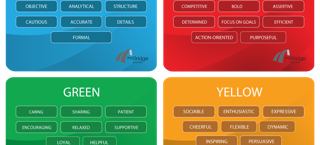
The 34 Bridge Personality dimensions are orga-
nized into 12 groups. Each group is represented by
a different color.
Normative-Ipsative split
When a candidate found it difficult to choose
between the items belonging to a particular Bridge
Personality dimension, a Normative-Ipsative Split
appears below that dimension in the report. The
“N” represents the normative score, while the “I”
represents the ipsative (forced-choice) score. 8 Figure 2: ‘normative-ipsative’ split
When a Normative-Ipsative Split appears for a
Bridge Personality dimension, it indicates that
the candidate found it difficult to express a clear
preference. This provides a useful starting point for
discussion. Together, the candidate and the assessor
can explore why this occurred. Rather than being
negative, a Normative-Ipsative Split often pro-
vides valuable insights, especially in development
settings where it may highlight areas for future
growth.
Contact & Management
ontact
The Contact group consists of the dimensions Soci-
able and Networking. Sociable measures the extent
to which you enjoy interacting with other people,
while Networking measures your preference for
meeting new people and building new relations-
hips.
anagement
The Management group consists of the dimensions
Decisive, Guiding, and Coaching. Decisive and
Guiding focus on task-oriented management, such
as making decisions and leading people and proces-
ses. Coaching reflects the people-oriented side of
management, including motivating and developing
others.
MANAGEMENT
DECISIVE
Makes decisions quickly
and easily
MANAGEMENT
GUIDING
Likes to have a managerial role
and prefers to have control
MANAGEMENT
COACHING
Motivates, coaches and
inspires other people
CONTACT
SOCIABLE
Likes to talk and likes to
be around people
CONTACT
NETWORKING
Focused on making
new contacts, finds
networking important
Influence & Disposition
nfluence
The Influence group consists of the dimensions
Convincing, Critical, and Socially Bold. Convin-
cing measures how strongly you try to influence
others, Critical reflects how critically you evaluate
information and ideas, and Socially Bold indicates
your confidence when presenting or interacting
with groups.
isposition
The Disposition group describes how you approach
your work and consists of the dimensions Method-
ical, Integrity, and Action Focused. Methodical
measures how structured and organized you work,
Integrity reflects your preference for confidentiality
and discretion, and Action Focused indicates how
much you enjoy working under pressure.
INFLUENCE
CONVINCING
Likes to negotiate and
is convincing
INFLUENCE
CRITICAL
Is critical and identifies weak
points in proposals and plans
INFLUENCE
SOCIALLY BOLD
Likes to give presentations and
is at ease with large
groups of new people
DISPOSITION
METHODICAL
Likes to plan and structure
work-related tasks
DISPOSITION
INTEGRITY
Is discrete, trustworhty and
keeps information confidential
DISPOSITION
ACTION FOCUSED
Likes to be busy and is able
to do multiple things
at the same time
Drive & Implementation
rive
The Drive group describes the energy you put into
your work and consists of the dimensions Initiative,
Career Focused, and Enterprising. Initiative mea-
sures how actively you start new tasks, Career Fo-
cused reflects your ambition to progress within an
organization, and Enterprising indicates your focus
on identifying new opportunities and challenges.
mplementation
The Implementation group describes how you
perform your work and consists of the dimensions
Detail Focused, Result Focused, and Awareness of
Rules. Detail Focused measures your attention to
facts and details, Result Focused reflects your drive
to achieve goals, and Awareness of Rules indicates
how much you value following rules and proce-
dures.
DRIVE
INITIATIVE
Is proactive and prefers
to initiate new things
DRIVE
CAREER FOCUSED
Is ambitious, competitive and
wants to make a career
in an organisation
DRIVE
ENTERPRISING
Identifies market opportunities
and actively seeks challenges
IMPLEMENTATION
DETAIL FOCUSED
Works carefully with a focus
on details and facts
IMPLEMENTATION
RESULTS FOCUSED
Is goal oriented and
achieves results
IMPLEMENTATION
AWARE OF RULES
Prefers to work in an
organisation in which
rules are important.
Social contact & Resilience
ocial contact
The Social Contact group describes how you inter-
act with and support others at work. It consists of
the dimensions Cooperative, Helpful, and Consi-
derate. Cooperative measures your willingness to
work with others, Helpful reflects how readily you
support colleagues, and Considerate indicates how
attentive and responsive you are to other people’s
needs and opinions.
esilience
The Resilience group describes how you cope with
challenges at work and consists of the dimensi-
ons Avoiding Conflict, Self-Confident, and Stress
Resistant. Avoiding Conflict measures how much
you adapt your behavior to others, Self-Confident
reflects your confidence in yourself and the future,
and Stress Resistant indicates how well you handle
pressure at work.
SOCIAL CONTACT
COOPERATIVE
Likes to work in teams
SOCIAL CONTACT
HELPFUL
Helps colIeagues and
other people
SOCIAL CONTACT
CONSIDERATE
Is involved and listens
to other people
RESILIENCE
AVOIDING CONFLICT
Is flexible and adapts behaviour
to the situation and the person.
RESILIENCE
SELF-CONFIDENT
Are satisfied with their
performance and have
confidence in the future
RESILIENCE
STRESS RESISTANT
Is able to handle high pressure
at work very well
Flexibility & Perception
lexibility
The Flexibility group describes how you adapt
to change at work and consists of the dimensi-
ons Openness to Feedback, Positive Attitude, and
Change Oriented. Openness to Feedback measures
how receptive you are to feedback, Positive At-
titude reflects your general outlook, and Change
Oriented indicates how comfortable you are with
change and new ways of working.
erception
The Perception group consists of the dimensions
Creative, Abstract, and Strategic. Creativity mea-
sures your focus on developing new ideas, Abstract
reflects your interest in theories and concepts, and
Strategic indicates your preference for long-term
planning.
FLEXIBILITY
OPENNESS TO FEEDBACK
Is open to feedback
from others
FLEXIBILITY
POSITVE ATTITUDE
Is cheerful and has a
positive attitude
FLEXIBILITY
CHANGE ORIENTED
Focuses on change and
does not like routine
PERCEPTION
STRATEGIC
Likes to think strategically
and prefers to develop
long-term plans
PERCEPTION
CREATIVE
Has original ideas and likes
to create new things
PERCEPTION
ABSTRACT
Is good at developing and
implementing theories
Opinion & Evaluation
pinion
The Opinion group describes how you learn, work,
and solve problems. It consists of the dimensions
Insight, Practical, and Inquiring. Insight measures
how much you rely on intuition, Practical reflects
your preference for hands-on learning and practical
solutions, and Inquiring indicates your desire to
learn new things.
valuation
The Evaluation group describes how you process
information, facts, and numbers. It consists of the
dimensions Analytic and Rational. Analytic mea-
sures how thoroughly you analyze information and
problems, while Rational reflects your preference
for working with numbers and technical details.
OPINION
INSIGHT
Is intuitive and gets to the heart
of the problem quickly
OPINION
PRACTICAL
Learns by doing and
likes practical work
OPINION
INQUIRING
Learns fast and is interested
in learning new things
EVALUATION
ANALYTICAL
Actively seeks information
and solutions to problems.
EVALUATION
RATIONAL
Likes to work with numbers
and objective facts
What are Jung Types?
he Jung Type theory was developed by the
Swiss psychiatrist Carl Gustav Jung. With his
theory he wanted to explain the normal differences
between healthy people. Based on his observations
he discovered that people have a born preference to
act in a certain way.
What are preferences?
The following exercise is often used to clarify what
exactly preferences are:
Write your first- and last name on this line:
----------------------------------------------------
Now, do the same thing, but this time with your
other hand:
----------------------------------------------------
You may have noticed that writing with your other
hand requires a lot more energy. People who have
done this exercise notice the following differences:
Writing hand
• Natural
• Automatic process
• Requires little energy
• I recognize this as my own handwriting
• Easy
Other hand
• Unnatural
• Requires a lot of energy
• Demands a lot of concentration
• I do not recognize this as my own handwriting
• Difficult
In the past, left-handed people were forced to write
with their right hand. If you insist on writing with
your non-dominant hand, you will eventually suc-
ceed, and it will cost you less energy over time.
Still, your underlying hand preference will not
change; you will remain left-handed. That is preci-
sely what Jung meant by preference behaviour. You
can teach someone to behave in a different way
as long as they are in an environment that expects
them to act that way. Their preference does not
change; they are simply learning to behave diffe-
rently.
Once you know what your preferences are, you will
know what behaviour demands little energy from
you and comes naturally. You will also know which
situations require you to adapt. Adapting will cost
you more energy, just like writing with your other
hand.
In his theory, Jung described four dimensions of
preference behaviour, with two poles per dimen-
sion:
1. Extraversion or Introversion
2. Sensing or iNtuition
3. Thinking or Feeling
4. Judging or Perceiving
According to Jungian theory, every human being
has a preference for one side of each of the four
dimensions. We use both sides, but never at the
same time and never with the same ease. When we
use the side that best fits our preference, we often
achieve our goals more easily and efficiently.
It is important to know that there are no good or
bad preferences. A preference simply reflects the
behaviour that demands the least energy from a
person. You can behave differently, but it will cost
you more energy.
How to assess your Jung Type
etermining your Jung Type consists of two
steps.
Step 1: Reported Type
The first step is completing The Bridge Persona-
lity questionnaire. Your Jung Type is provided in
your report. There you will find, aside from general
information about your Type, specific information
on how your Type handles communication, ma-
nagement style, conflict resolution, and stress. The
Type that appears in your report is also referred to
as your reported Type.
Step 2: Self-assessed Type
The second step is reading the Jung Type informa-
tion provided in this booklet. Complete the hand-
writing exercise and keep this question in mind for
each dimension: ‘Which pole represents my prefe-
rence behaviour and requires the least amount of
energy?’ Please note while determining your Jung
Type: there are no good or bad preferences; it is
entirely about the preference that fits you best.
While determining your Jung Type, please note:
• There are no right or wrong answers. Your Jung
Type reflects the behavioural preference that
suits you best.
• People often behave differently in their private
lives than they do at work. For each dimension,
consider which behaviour requires the least
amount of energy, whether at work or in your
private life.
• It is possible that your current employment
demands a behaviour that does not align with
your natural preference. For instance, a person
with a strong preference for Intuition (N) might
work in an accounting department. They may
have learned to work with numbers, but this is
not their innate preference; they have simply
been taught Sensing behaviour. However, their
underlying preference remains Intuition (N).
• The Jung Type you assess for yourself is called
the self-assesssed Type.
There is a chance that your reported Type and self
assessed Type match. If they do not, follow these
steps:
• Carefully read the descriptions of both your
reported Type and your self-assessed Type, and
decide which of the two you recognize yourself
in the most.
• Pay close attention to the parts of the Type des-
cription in which you do not recognize yourself.
These parts likely belong to the side of the
dimension you are questioning.
• Imagine how other people see you. What type
description would they pick for you?
Furthermore:
• You determine your own Jung Type; nobody
else can do it for you.
• Are you unable to just choose one Jung Type?
Give it some time and think about it for a while.
• t is entirely possible that you will continue to
hesitate between opposing poles on a dimen-
sion. This happens very often and is not some-
thing to worry about.
The 4 Jung Dimensions
n this chapter, you will find a description of the four Jung dimensions. Try to decide what your preference
is for each dimension, and write down its corresponding letter. For example, if you prefer Introversion on
the Extraversion–Introversion dimension, write down the letter I. Do this for all four dimensions to find your
four-letter combination. This combination is your self-assessed Jung type.
What kind of information do you prefer?
INtuiton
Preference for taking in information
through a "sixth sense" and noticing
what might be.
• Look for new, improved ways for
doing things
• Seek the big picture
• Focused on the future
• Intuition, using their insight
• Ask first: ‘Why’?
Sensing
Preference for taking in information
through the five senses and noticing what
is actual.
• Continuïty and tradition
• Details, specifics
• Focusses on the here and now
• Clear points and direction
• Ask: who, when, what and
where?
Where do you get your energy from?
Prefers to get energy from their inner
world. Get energy from thoughts,
feelings and ideas.
• Focussed on the inner world
• Think first, act later
• Seek internal reflection
• Think in silence
• Get their energy from internal
thoughts
Prefers to get energy from the outside
world. Gets energy from other people
and activities with other people.
• Focussed on the external world
• Talk first, act later
• Actively seek interaction
• Think out loud
• Get their energy from people
Extraversion Introversion
The 4 Jung Dimensions
How do you make decisions?
Feeling
Preference for deciding in a personal,
value-based way.
• Empathy
• Diplomatic skills
• Warm, friendly, emotional
• Prefer feelings and emotions
• Subjective criteria
Thinking
Preference for deciding in a logical,
objective way.
• Analytical, logical, not personal
• Direct
• Rational decisions
• Prefer a logical order of things
• Objective criteria
How you deal with the outer world?
Perceiving
Preference for living a spontaneous and
flexible life and like to keep their options
open.
• Prefer flexibility
• Like openness
• Like to keep things open
• Delay making plans
• Adapting and changing
Judging
Preference for living a planned and
organised life in which things are
decided.
• Prefer structure
• Like to finish things
• Set deadlines
• Prefer making plans
• Controlling & structuring
The Jung Type Table
ISTJ
Realist
They are hard-working, neat
and thorough. They can work
well within a traditional
structure, where there are
standard procedures and where
they can keep a good eye on the
details and facts. They like
efficient procedures, and find
traditions and loyalty important.
They enjoy arranging and
organising.
ISTP
Solver
Are tolerant, pragmatic and
flexible. They like rules and
the practical application of
their knowledge. They are
good at processing large
amounts of data and analysing
them to find the core of a
practical problem. They are
interested in cause and effect,
and can identify illogical or
inconsistent data or procedu-
res.
ESTP
Doer
Are friendly, can adapt easily
and is focused on action. Their
goal is to get quick results.
They want to remove obstacles
through a pragmatic, no-non-
sense approach. They often do
not have the patience to listen
to a long explanation.They can
get on well with people. They
are result-oriented and
action-focused.
ESTJ
Decision maker
Are practical, directive,
business-like and organised.
They are good at organising
projects and they deploy
people in order to get things
done. They strive to achieve
results efficiently and have an
eye for detail in this. They
work hard, are responsible
and look for practical and
realistic solutions.
ESFJ
Service provider
Are helpful, warm and
friendly towards others and
enjoy working in a harmoni-
ous environment. They are
loyal and persevering, even in
less important matters. They
like to help others in a
practical way and adopt a
social position. They will try
to improve things for all
concerned.
ENFJ
Coach
Are warm, empathetic and
friendly towards people. They
focus strongly on the emotions
and feelings of others. They
are loyal and sensitive to
compliments and criticism.
They are social and supportive
of others, and can inspire
people through their leader-
ship. They perceive qualities
and possibilities in everyone.
ENTJ
Leader
Are often outspoken,
assertive and quick to
assume leadership. They
enjoy managing projects and
bring order and logic to tasks
and work processes. They
like to make long-term plans
and goals. They invent
systems and processes for
solving organisational
problems.
ESFP
Performer
Are friendly, energetic and
enthusiastic. They can be
characterised as bon vivants,
and they gladly use humour
and vitality to get things
done. They like people and
(material) comfort. They
enjoy helping people, and use
their warmth and generosity
in this. They learn well in a
group.
ENTP
Innovator
Are quick, alert and
straightforward. They are
creative in finding
solutions for difficult
situations or problems.
They are good at improvi-
sing and delivering new
concepts. They like
change, and do not like
routine. They do not often
do things the same way
twice.
ENFP
Inspirer
Warm, enthusiastic and often
charismatic and encouraging.
They enjoy being innovative
and creative, and motivating
others to take action or teaching
them new things. They look for
a lot of confirmation from
others, but are also quick to
give support and compliments
themselves.
ISFP
Peacemaker
Are calm, modest and friendly.
They focus on the here and
now, and on what is happening
in their immediate surroun-
dings. They value harmony
and respect for one another. In
their work, they focus on
friendliness and creativity, and
on taking account of
colleagues. They like having
their own space and their own
work or time arrangements.
INFP
Idealist
Idealists are guided by their
values and ideals. They
enjoy helping others,
contributing to meaningful
goals, and supporting
personal growth. They are
future-oriented, open-min-
ded, and motivated to make
a positive difference. They
are flexible, unless their
core values are challenged.
INTP
Strategist
They are analytical and look
for logical explanations for
everything they are
interested in. They like to
work independently and
enjoy searching for the truth
and solving complex
problems through a rational
approach. They are theoreti-
cal and abstract.
ISFJ
Carer
They are loyal, dedicated,
often calm and responsible.
They meet their obligations
and agreements. They like it if
roles and responsibilities are
clear and well divided. They
look for stability and harmony
in their dealings with others.
They are actively concerned
with other people’s feelings.
INFJ
Advisor
They often have great insight
and have a preference for
working creatively. They try
to understand what motivates
others. They keep to their
norms and values, and are
led by their conscience. They
try to make a conscious
effort for the general interest
and want to develop an
atmosphere of mutual trust.
INTJ
Scholar
They are original, indepen-
dent and enthusiastic in
achieving their goals. They
like to develop strategies
and long-term plans and
are forward-looking in
general. They do not avoid
difficult and complex
situations. They see them
as more of a challenge and
are quick to perceive a
structure in them.
ISTJ - Realist
ealists have a high sense of responsibility and
are loyal to the organisation they work for, as
well as to their families, friends and other relation-
ships in their life. They are committed to comple-
ting their tasks accurately and on time. They will
put a lot of effort into completing the tasks they
find important, but they dislike carrying out a task
that they consider unproductive. Realists give high
priority to responsibility and professionalism. They
can also place high demands on others concerning
responsibility and standards of duty.
Preferences of the Realist:
• Practical, realistic and impartial.
• Able to work in a structured and systematic
way
• Extremely thorough, responsible and reliable
• Well-organised and hard workers
• Work steadfastly towards set goals
How do others see Realists?
ealists will behave socially and in a people-oriented
way when they feel at ease in their role. They will
not share their opinions and feelings with everyone;
they will probably only do this with good friends.
They sometimes have a hard time understanding
things that they see as unimportant. However, once
they are convinced that something is important to
someone else, they will do their utter best to sup-
port it, even if they themselves do not think it is of
any importance.
Others see the Realist as:
• Timid
• Serious
• Clear
• Honest
• Structured
• Loyal to rules and structure
Pitfalls & Points of Development
When Realists find themselves in an environment
where their traits and talents are not practical, there
is a possibility they will:
• Sometimes incapable of seeing the broad con-
text of their decisions
• Rely so strongly on their own logic that they
forget their decisions have certain effects on
others
• Act pragmatically and coldly, which may inti-
midate people who need contact and intimacy
ISFJ - Carer
arers are reliable and thoughtful. They are
committed to individuals and groups with
whom they have a connection, and are very loyal
in fulfilling their commitments. They are persistent
in achieving their goals completely and ahead of
time. Carers will do a lot to accomplish the tasks
they think are important; however, they dislike car-
rying out a task that they do not consider produc-
tive. Carers focus on the needs of others and set up
specific procedures to ensure that those needs are
fulfilled. They have a high sense of responsibility
and expect others to have that as well.
Preferences of the Carer:
• Timid, kind and conscientious
• They can be relied on to get things done
• They subordinate their own feelings to those of
others
• Perceptive to feelings of others
• Helpful, thoughtful and caring towards others
• Kind and friendly
How do others see Carers?
Carers are modest and quiet when socialising with
others. They often prioritise the needs of others,
especially those of family members. They dislike
confrontations or arguments, and when they find
themselves in such a situation, they tend to adopt a
flexible and accommodating attitude. They dislike
people who behave disrespectfully or tactlessly.
Other people often notice their need for structure
and kindness.
Others see Carers as:
• Timid
• Conscientious
• Thoughtful
• Helpful
• Loyal to traditions
Pitfalls & Points of Development
When Carers are unable to use their natural streng-
ths and talents in their work or environment, they
may:
• Cling to authority, structure and procedures
• Feel unappreciated, which may cause them to
complain
• Struggle to defend their own needs.
• Struggle to separate personal relationships from
objective decisions.
ESTP - Doer
oers are often energetic, active problem sol-
vers. They respond creatively to challenges in
their environment. They dislike rules or procedu-
res and actively look for ways to improve existing
systems and solve hard tasks. They often feel great
joy doing their job. They are flexible and inventive.
They are welcome guests and inspire others with
their vitality. They are interested in people, new
things and experiences. They learn more easily by
doing than by reading; they prefer to just start.
Preferences of the Doers:
• Kind, easily adapting and action-orientated
• Looking for quick results
• They live in the ‘here and now’
• Risk takers with a fast lifestyle
• Impatient when it takes too long to explain
something to them
• Can deal well with people
How do others see Doers?
Others see Doers as pleasant company and people
who enjoy life. They are often enthusiastic and exu-
berant and that trait attracts others. They rarely plan
in advance but trust on their improvisation skills
when they find themselves in certain situations.
Others see Doers as
• Good company,
• Kind
• Supportive
• People who like action
• People how like having fun
Pitfalls & Points of Development:
When Doers work in an environment where they
are unable to use their natural strengths and talents,
they may:
• Be unaware of the effects of their action on
others
• Act impatiently
• Pay too much attention to exciting activities
• Prioritise fun things instead of their obligations
ESFP – Performer
erformers enjoy company and like having fun;
they are often exuberant hedonists. They live
for the moment and enjoy people, food, clothes,
animals, nature and activities. They do not bother
following the rules and try finding new ways to
fulfil their needs and those of others. They coope-
rate easily and enjoy performing their job with as
much joy as possible, preferably with a lot of fun.
Performers are interested in people, new things and
experiences. They like learning new things by sim-
ply doing them; they often rush into activities and
learn new things that way.
Preferences of Performers:
• Sharp and perceptive
• Practical, realistic and ‘to the point’.
• Focused on people and love having fun
• Live for ‘the moment’, enjoy new experiences
• They are most likely the centre of attention in
social situations
How do others see Performers?
Performers are often characterised as real hedo-
nists, which makes them pleasant company. They
are exuberant and enthusiastic, and this trait attracts
other people. They do not plan ahead, preferring
to trust in their improvisation skills to respond to
situations. They dislike structure and routine, and
are always on the lookout for new things.
Others see Performers as:
• Resourceful
• Friendly
• Helpful
• People who enjoy having fun
Pitfalls & Points of Development
When Performers work in an environment where
they are unable to use their natural strengths and
talents, they may:
• Act distracted
• Take decisions impulsively
• Have trouble respecting deadlines
• Prioritize fun instead of work
• Avoid hard or complex situations
INTJ – Scholar
n general, Scholars have a clear picture of their
future and they are motivated organisers. They
want to bring their ideas to practice. They like a
complex challenge or situation; they easily see a
simpler structure in difficult situations or theories.
They appreciate their own knowledge and skills but
also those of others. They dislike chaos, confusion
or working inefficiently. They may trust their gut
feeling to construct complex structures or ideas for
the future.
Preferences of Scholars:
• Independent, original and determined
• Able to convert ideas into actual plans of action
• Appreciate knowledge, skill and structure
• Long-term thinkers
• Want to raise the bar for themselves and others
How do others see Scholars?
Scholars are often considered quiet, determined and
confident people. They dislike small talk, especially
with strangers. They do not always show their most
appreciated side—their creative insights. They do,
however, come up with logical decisions, opinions
and plans. They are sometimes considered way-
ward, which often surprises the Scholar. This is be-
cause they see themselves rather as someone who is
willing to revise their opinion, provided that there
is enough evidence or there are other valid reasons
to back up the alternative vision.
Others see Scholars as:
• Reserved
• Inscrutable
• Keep their distance
• Original and independent
Pitfalls & Points of Development
When Performers find themselves in an environ-
ment where their traits and talents are not practical,
there is a possibility they will:
• Overlook certain details and facts when these
do not fit with their creative idea
• Become distant and curt
• Give little information about what is happening
in their mind
• Show less appreciation for other people
INFJ – Advisor
dvisors often have great insight and a prefe-
rence for working creatively. They try to un-
derstand what motivates others. They keep to their
norms and values, and are led by their conscience.
They try to make a conscious effort for the general
interest and want to develop an atmosphere of mu-
tual trust. They focus on achieving long-term goals.
Preferences of Advisors:
• Timid, powerful and sensitive
• Tend to persevere until something is finished
• Intuitive when conversing with people and wor-
ried about their feelings
• Well-developed standards and values to which
they strictly adhere
• They are respected for their endurance in doing
‘the right thing’
How do others see Advisors??
Advisors are often compassionate; they show
empathy when it is needed. They can sometimes
be considered mysterious or difficult to read be-
cause they tend to keep their intuitive thoughts
to themselves. When they do want to share their
convictions, they may use complex language and
metaphors. They appreciate authenticity and sincere
relationships. Although Advisors are often reserved,
they will certainly rebel when their values are being
compromised.
Others see Advisors as:
• Withdrawn
• Individualistic
• Compassionate
• Intuitive
Pitfalls and Points of Develop-
ment
When Advisors find themselves in an environment
where their traits and talents are not useful, there is
a possibility they will:
• Give people around them insufficient informa-
tion concerning the background of their decisions
• Become critical
• Have a hard time translating their inner insights
into clear words
• Chase their own vision and strategy in their
own typical way
ENTP – Innovator
nnovators are constantly looking for opportuni-
ties and possibilities in their environment. They
see patterns and connections that others overlook.
They are good at elaborating concepts, which they
then strategically analyse. Innovators have a clear
view of how systems operate. They are often ad-
venturous and resourceful. They are stimulated by
problems and easily come up with ideas.
Preferences of Innovators:
• Creative, resourceful and easy intellectual agile
• Good at many different things
• Enjoy discussions and sometimes want to do
things a little better than the next person
• Almost always an open book and assertive
• They enjoy people and are stimulating company
• Possess excellent traits to understand concepts,
apply logic and come up with solutions
How do others see Innovators?
Innovators are often spontaneous and they adept ea-
sily. They dislike it when a lot of rules and restricti-
ons are imposed on them; they try to avoid these as
much as they can. Innovators will always convince
others of their vision by using their enthusiasm and
vigour. They like being an active, challenging and
stimulating member of a discussion.
Others see Innovators as:
• Independent
• Creative
• Vivid
• Enthusiastic
• Energetic
• Assertive and direct
Pitfalls and Points of Develop-
ment
When Innovators find themselves in an environ-
ment where their traits and talents are not useful,
there is a possibility they will:
• Abruptly express their ideas and principles,
which can seem to challenge othersJump from
one idea to the other without finishing anything
• Criticise others, especially if they think those
others are not capable or skilful
• Pay less attention to details that are essential for
achieving their plans
• Focus on one unimportant detail and consider
this as extremely important
ENFP – Inspirer
nspirers see life as a creative adventure filled
with exciting possibilities. They have excel-
lent people skills, behave empathetically and have
good insight into the present and future. They need
confirmation from others and give appreciation in
return. They want to live their lives according to
their inner values and norms. Inspirers have a good
understanding of how people and groups work.
They are convincing and compelling in their pursuit
of things they find important. Their enthusiasm can
encourage others to get the best out of themselves.
Preferences of Inspirers:
• Personal, remarkable and convincing
• Enthusiastic, idealistic and creative
• They have excellent skills to deal with people
• Excited by new ideas, but are bored by details
• Flexible, with a wide variety of interests and
skills
How do others see Inspirers?
Inspirers are often lively and enjoy company. They
also invest a lot of attention into open and vibrant
communication; relationships are important to
them. They like being part of a group because their
enthusiasm and energy are catchy. This motivates
others.
Others see Inspirers as:
• Warm
• Friendly and compassionate
• Helpful
• Empathetic
• Good with people
• Curious
• Full of imagination
Pitfalls & Points of Development
When Inspirers find themselves in an environment
where their traits and talents are not practical, there
is a possibility they will:
• Intensely express their feelings and values
• Come up with a lot of enthusiastic ideas that
they cannot use or execute
• Become incoherent or have a hard time concen-
trating and get easily distracted
• Ignore details and procedures
ISTP- Solver
olvers thoroughly observe what is happening in
their environment. When necessary, they will
react quickly to a challenge. They look for the core
of a problem and try to solve it as efficiently as
possible with the least amount of effort. They like
to know how things work, but find abstract theo-
ries uninteresting unless they can be applied easily.
They often serve as problem solvers. They are quiet
and reserved, interested in how and why things
work.
Preferences of Solvers
• Do not avoid problems
• Uncomplicated in their desires
• Loyal to their equals and their own values
• Do not worry about laws and rules when these
stand in the way of accomplishing something
• Distant and analytical
• Excel in finding solutions to practical problems
How do others see Solvers?
Solvers think that all human beings should be
treated equally, they tolerate the most diverse styles
of behaviour. They do have clear basic principles
and can be determined to defend them. Solvers can
easily adept their behaviour when this helps them
solve a problem or situation. Sometimes others
have a hard time understanding this behaviour.
Others see Solvers as:
• Compliant
• Focused on action
• Prepared to take risks
• Independent
• Determined
Pitfalls & Points of Development
When Solvers find themselves in an environment
where their traits and talents are not practical, there
is a possibility they will:
• Focus too much on a solution, which results in
them losing track of the consequences of their
actions
• Overlook the emotional needs of others
• Pay too little attention to the consequences of
their decisions for others
• Become cynical when they disagree with a
solution
INTP - Strategist
trategists are independent problem solvers.
They are good at giving a concise analysis of
an idea or situation. They prefer working on a pro-
blem or situation independently. Strategists can be
very enthusiastic about theories and ideas. They are
extremely driven to convert theories into understan-
dable language. They highly appreciate knowledge,
skill and logic. Strategists challenge themselves and
others to think up new logical approaches.
Preferences of Strategists:
• Logical, original and creative thinkers
• Unbiased and independent
• Are curious about new theories
• Easily see contradictions
• Dislike routine tasks
• Easily see contradictions and illogical things
How do others see Strategists?
Strategists are quiet when conversing with others
and remain impartial. Subjects that fascinate them,
or that they are experts in, will be common conver-
sation topics for them. In the workplace, they are
more interested in coming up with solutions than
practically executing them. They like the exact
truth, but sometimes they explain things in quite
a complex way, which can give others a hard time
understanding it.
Others see Strategists as:
• Quiet
• Self-controlled
• Independent
• Self-sufficient
• Logical
Pitfalls & Points of Development
When Strategists find themselves in an environ-
ment where their traits and talents are not useful,
there is a possibility they will:
• Have trouble bringing their ideas to practice
• Seclude themselve and postpone things
• Become insensitive to other people’s need for
information
• Be unpractical and overlook details
ESTJ- Decision maker
ecision makers like organising projects,
operations and procedures. They are often
traditional and organised. They like leading people
and enjoy finishing projects. They live according to
a set of guidelines and norms; they will systemati-
cally endeavour to stick to them and expect others
to do the same. They like competent people and ef-
ficient procedures, and they will show appreciation
for them. Decision makers are great team players,
as long as the other team members stick to their
deadlines and tasks.
Preferences of Decision makers:
• Not interested in theories or abstraction unless
they see the use of it
• Have a clear vision of how things should be
• Loyal and hard workers
• Like to call the shots
• Skilful in organizing and running activities
• Appreciate stability and a peaceful existence
How do others see Decision
makers?
Decision makers are often seen as people who like
bringing things to a successful conclusion. Others
count on Decision makers to come up with sys-
tems, plans and procedures, and to take decisions
if needed. Decision makers are bright and clear
communicators, so others quickly know where they
stand. They can be quite social and like to associate
with other people.
Others see Decision makers as:
• People who are conscientious
• Reliable
• Confident
• Focused
Pitfalls & Points of Development
When Decision Makers find themselves in an
environment where their traits and talents are not
practical, there is a possibility they will:
• Make rash decisions without studying the ne-
cessary information
• Act strict and consequent
• Be impatient with confusion or with people
who act inefficiently
• Only have an eye for things that give a direct
result
• Focus too much on logic and too little on emoti-
ons and feelings of people
ENTJ- Leader
eaders are often strategic visionaries and are
good at planning their tasks. They are decisive
and feel the need to steer people and organise situ-
ations. They easily develop a concept or idea and
are good at growing these into a comprehensive
strategy for an organisation. They are often asser-
tive and open-hearted, and they are naturally driven
to leadership. They like order and continuity, which
makes them feel more comfortable in environments
where work plays an important role and where the
rules are clear.
Preferences of Leaders:
• Excellent skills to understand difficult organiza-
tional problems
• Strongly focused on coming up with effective
solutions
• Are normally very good at speaking in public
• Believe knowledge and skill are important
• They usually have little patience for ineffici-
ency and disorganisation
How do others see Leaders?
Leaders are recognisable in groups by their honesty
and direct approach. They like to tackle difficulties
as fast as they can. They treat everyone as equals.
They are not always warm, but they are always
honest. They like a stimulating relationship with
other people and extract energy from it. They often
challenge the opinions and actions of others and
expect them to defend their views.
Others see leaders as:
• Decisive
• Assertive
• Honest
• Direct
• Confident
Pitfalls & Points of Development
When Leaders find themselves in an environment
where their traits and talents are not practical, there
is a possibility they will:
• Overlook other people’s need for compliments
and validations
• Become overly critical
• Overlook details and facts
• Run a schedule that is too tight and forget to
take in account the consequences for other
people
• Take decisions that are too one-sided without
consulting others
ISFP- Peacemaker
eacemakers live in the present and enjoy peace.
They take their time to experience every second
of their life. They like the freedom to go their own
way, to have their own space and to set their own
schedule. Peacemakers can be sensitive to trends
and are often more aware of the newest styles than
other types. Many Peacemakers have an artistic
talent and occupy themselves with decorating,
designing and painting. They dislike conflict and do
not like participating in events that can easily evoke
tension.
Preferences of Peacemakers:
• Timid, serious, sensitive and kind
• Loyal and faithful
• Not interested in leading or controlling others
• Flexible
• Highly original and creative
• Enjoy the present moment
How do others see Peacemakers?
Peacemakers adapt easily. They are flexible unless
something that is important to them is being thre-
atened. They care a lot about other people, expres-
sing this more through their actions and helpfulness
than through their words. They feel a stronger
urge to observe and support than to organise. They
dislike dominating others. They sometimes feel the
urge to avoid making decisions and tend to unde-
restimate their own achievements.
Others see Peacemakers as:
• Skilful
• Representative
• Flexible
• People with a good sense of humour
• Creative
• Helpful
Pitfalls & Points of Development
When Peacemakers find themselves in an environ-
ment where their traits and talents are not useful,
there is a possibility they will:
• Reject or mock logical systems
• Feel too overwhelmed to progress through com-
plex matters
• Overlook the broad context of a decision
• Work less carefully and leave certain things
unfinished
INFP- Idealist
dealists have a strong commitment to their values
and ideals. They like engaging in activities that
contribute to these values, and are focused on
both their own growth and the growth of others.
They enjoy sharing their values and ideals with the
people around them. They are often interested in
serving humanity. They are flexible and relaxed, as
long as their treasured values are not endangered.
Idealists like thinking and talking about possibi-
lities to change things for the better in the future.
They often have a lot of energy and are deeply
committed to projects they find important.
Preferences of Idealists:
• Quiet
• Reflective
• Idealistic
• Loyal
• Mentally quick, often seeing new possibilities
• Interested in understanding and helping people
• Faithful to their own ideas
How do others see Idealists?
Idealists dislike environments where a lot of rigid
structure and rules are enforced; they prefer wor-
king on their own. They can adapt well to others,
but only if it does not conflict with their values.
They do not easily express their deepest convic-
tions or feelings, which can make them appear
reserved. They value deep and sincere relations-
hips, and they appreciate people who take the time
to truly understand their values.
How do others see Idealists?
• Sensitive
• Independent
• Original
• Friendly
• Sometimes hard to understand
• Flexible
• Complex
Pitfalls & Points of Development
When Idealists find themselves in an environment
where their traits and talents are not practical, there
is a possibility they will:
• Have a hard time expressing themselves ver-
bally
• Withdraw from other people and rarely inter-
actReject logical points of view
• Become impractical
• Share too little information with others
ESFJ - Service provider
ervice Providers (ESFJ) are dedicated to being
of service. Of all the personality types, they
are the most social, and their core trait is providing
for the needs of those around them. This applies at
work, with family, acquaintances or friends. They
feel encouraged by the approval of others and hurt
by indifference or unfriendliness. They feel un-
comfortable in conflict situations and tense envi-
ronments, and will do everything they can to avoid
them. They feel a strong urge to prioritise the needs
of others..
Preferences of Service providers:
• Kind-hearted, popular and conscientious
• Strong sense of responsibility and duty
• Appreciate traditions and safety
• Need positive validation to feel good about
themselves
• Well-developed awareness of their physical sur-
roundings
How do others see Service
providers?
Service Providers feel most comfortable in structu-
red situations and like creating order, structure and
plans. They prefer doing everything the traditional
and accepted way. To maintain harmony, Service
Providers will act compliantly and will sometimes
avoid conflict. They have strong values and norms
that they can express quite obviously when they
find it necessary. Service Providers place a high
value on family and social relationships..
Others see Service Providers as:
• Practical
• Down-to-earth
• Determined
• Consistent
• Customer friendly
• Flexible
Pitfalls & Points of Development
When Service Providers find themselves in an
environment where their traits and talents are not
practical, there is a possibility they will:
• Feel hurt by indifference and conflict
• Doubt themselves and feel overly responsible
for others
• Worry and feel guilty about things outside their
control
• Become nosy in their pursuit to help others.
• Support people unconditionally
ENFJ – Coach
oaches (ENFJ) understand people, care for
them and have a special quality that brings
out the best in others. They offer care and support,
making sure everybody is having a good time. They
are completely focused on understanding, suppor-
ting and encouraging others. A Coach enjoys being
the centre of attention, where they inspire and lead
people. They look for the good in others and bring
out their full potential. They value harmony and
cooperation.
Preferences of Coaches
• Great people skills
• Extravert, with genuine interests in how others
think and feel
• Usually dislike being alone
• They observe everything from a human per-
spective
• Extremely effective in dealing with private mat-
ters
How do others see Coaches?
Coaches are deeply interested in people. They listen
to others but also have strong, expressive opinions
of their own. They get energised by conversing
with other people and are highly social. They prefer
an organised life and try to resolve any ambiguities
or tensions with others as quickly as possible.
Others see Coaches as:
• Social
• Sympathetic
• Compassionate
• Convincing
• Someone who is aware of others
Pitfalls & Points of Development
When Service Providers find themselves in an
environment where their traits and talents are not
practical, there is a possibility they will:
• Worry and feels guilty
• Become too pushy in their pursuit of harmony
• Pay little attention to a logical approach
• Overlook details
• Not accept that they have a problem with peo-
ple they care about
To remember about Types
The 16 types are not static boxes. Your four-letter
type is more than a mere combination of letters; it
is the interaction of your preferences.
The Jung Types highlight your preferences, but
they tell you nothing about your intelligence or
skills. Therefore, your type does not determine how
capable you are at a certain task.
There are no good or bad types, and there are no fa-
vourable or unfavourable combinations of types at
work or in relationships. Every type and every indi-
vidual has their own special talent. Every person is
unique. Consequently, every ESTJ is different, and
so is every ISTP.
Everybody uses all of the preferences at some
point—meaning both sides of every dimension.
Your type simply consists of the sides that you
naturally prefer.
You are the one who can decide most accurately
which type fits you best. Your type does not pro-
vide an explanation for everything; an individual’s
personality is far more complex than that.
Application of the Jung Types:
In organisations, the Jung Types are used for many
purposes. They are excellent instruments for stimu-
lating self-knowledge and personal development.
They can also be used to:
• Improve communication
• Solve problems
• Accelerate decision-making
• Deal with stress and work pressure more accu-
rately.
• Teambuilding
• Facilitate training
• Support management development
• Construct cohesive teams
Type instruments, such as The Bridge Personality,
are the most commonly used personality question-
naires in companies and other organisations. In
fact, 90% of the top 100 stock-market-listed or-
ganisations use a type instrument. It constitutes a
widely accepted method for determining behaviou-
ral preferences.
Much is known and written about Types. For
further application of Types, we recommend the
following literature:
• The Bridge Personality: application in teams
• The Bridge Personality: the book for sales
Jung Types at work
he Jung Types represent the behavioural prefe-
rences that cost the least amount of energy. The
theory makes no estimation about the suitability of
a person for a specific kind of task, nor does it say
anything about their intelligence or skills. It is for
this reason that using Jung Types during a recruit-
ment or selection procedure is highly discouraged.
People can develop certain skills regardless of their
Jung type. However, we can predict the typical
behaviour that these types will display on the work
floor, regardless of their job description.
Employees with a preference for Extraversion like
action and variety, and they love conversing with
people. They learn new things by talking and doing.
They are interested in how others do their work and
remain highly focused on external collaboration.
Employees with a preference for Introversion focus
on peace and quiet at work, as this allows them to
concentrate properly. They learn new skills by rea-
ding and thinking things over. They enjoy working
alone and prefer developing ideas through reflec-
tion rather than through discussion.
Employees with a preference for Sensing focus on
things that are part of everyday life. They take a
realistic and practical approach. In their work, they
base their conclusions on carefully collected facts.
They believe experience is important and always
try to learn from it.
Employees with a preference for Intuition draw
upon their inspiration or gut feeling in their work.
They try to see the connections between multi-
ple tasks and remain focused on the future. They
believe change is important and will try to come up
with new approaches, often being highly creative in
the process.
Employees with a preference for Thinking work
task-orientated. They focus on causes and con-
sequences, they use logical analyses. They like
honesty and respect between co-workers.
They are determined, critical when it is necessary
and work with principles.
Employees with a preference for Feeling are peo-
ple-focused. They focus on human values and the
feelings of their co-workers. They value harmony,
offering support and empathy to the people around
them.
Employees with a preference for Judging like
working with clear structures and enjoy organising.
They prefer fixed routines and making firm decisi-
ons. They aim to finish their projects on time and
consistently meet their deadlines.
Employees with a preference for Perceiving like
to work flexibly and keep their options open. This
leaves room for adaptability, which is why they
may postpone final decisions at work. They try not
to let themselves be restricted by rigid plans and
procedures.
Jung types en professions
t is not recommended to use The 16 Jung Types
for selecting personnel. However, there is a clear
pattern regarding the kinds of professions different
types prefer to pursue.
The combination of Sensing and Intuition (S or N)
with Thinking and Feeling (T or F) often determi-
nes professional preference:
ST Preferences
People with an ST preference are focused on facts
and objective analysis. They are practical and ana-
lytical, which is why they often choose a profession
that reflects their interest in technical skills, physi-
cal objects, or concrete data.
Professions
Applied sciences, Business services, Adminis-
tration, Banking, Law Enforcement, Production,
Construction.
SF Preferences
People with an SF preference combine a focus on
facts with personal warmth and a desire to take
care of others. They are often compassionate and
friendly, which is why they tend to choose a profes-
sion where their interest in practical aid and service
is required.
Professions
Healthcare, Civil Service, Education, Hospitality
and services, Sales.
NF Preferences
People with an NF preference are focused on pos-
sibilities and nurturing the potential of others. They
are often insightful and enthusiastic, meaning they
frequently choose a profession where understan-
ding and encouraging people is essential.
Professions
Human resources, Education, Research, Literature,
Healthcare, Arts & Music.
NT Preferences
People with an NT preference focus on possibili-
ties, theoretical concepts, and systems. They are
inherently logical and analytical, which is why they
regularly choose a profession that involves theoreti-
cal and logical structures.
Professions
Exact sciences, Research, Management, ICT, Law,
Engineering.
Bridge Competencies
esides providing an overview of personality
dimensions and types, The Bridge Personality
also provides a score on the eight most common
competencies in the business world and the civil
service. The assessment system has been set up in
such a way that other competencies can be included
in the report upon request. The competencies in
The Bridge Personality relate strictly to the perso-
nality component of a competency—not to compo-
nents like IQ, skills or motivation. As an example:
the score on the competency Relationship manage-
ment is calculated by using the scores on the Bridge
dimensions: Networking, Sociable, Socially bold
and Considerate.
Supporting others
To what extent is someone focused on supporting
other people? This competency is measured by
combining the scores on the dimensions Coopera-
tive, Helpful, Considerate and Coaching.
Managing
How skilled is someone at management? This com-
petency is measured by combining the scores on
the dimensions Decisive, Guiding, Coaching and
Socially bold.
Achieving goals
To what extent is a person goal-oriented? This
competency is measured by combining the scores
on the dimensions Shows initiative, Career-oriented
and Result-oriented.
Adapting to change
To what extent is a person able to adapt to chan-
ges? This competency is measured using the scores
on the dimensions Positive attitude, Focused on
change and Open to feedback.
Communication focused
To what extent is a person focused on communica-
tion? This competency is measured by combining
the scores on the dimensions Networking, Sociable,
Open to feedback and Cooperative.
Innovating
To what extent is a person focused on innovation?
This competency is measured by combining the
scores on the dimensions Creative, Strategic, Focu-
sed on change and Shows initiative.
Inspiring others
How well can someone inspire other people? This
competency is measured by combining the scores
on the dimensions Convincing, Socially Bold and
Guiding.
Relationship management
How good is someone at managing relationships?
This competency is measured by combining the
scores on the dimensions Networking, Sociable,
Socially self-confident and Considerate.
Customized Competency Reports
The Bridge Personality offers a range of tailored
reports for different roles and industries. In addition
to the standard personality report, you can choose
specialized reports for managers, sales professio-
nals, legal professionals, finance, customer service,
and more. We can also create fully customized
reports for your organization. Simply provide the
eight competencies that are most important for the
role, and we will develop a report that measures
and reports on those competencies, giving you
insights that match your recruitment and develop-
ment needs.
he 4-colour personality model is a simple and
accessible framework that provides insight into
ourselves and others. Everyone has all four colours
within them; it is the combination of these four colours
that makes us unique. The four colours refer to beha-
vioural traits that we tend to show most naturally or
easily:
Blue: Unbiased, objective, reserved, analytical, ac-
curate, detail-oriented.
Green: Quiet, calm, soothing, caring, relationship-
oriented, harmonious, relaxed, supportive.
Yellow: Cheerful, uplifting, spirited, lively, dyna-
mic, enthusiastic, visionary, expressive.
Red: Positive, decisive, sharp, assertive, action-
oriented, demanding, determined, goal-focused,
strong-willed.
The scores on the four colours are calculated based
on your responses during The Bridge Personality
assessment. We all use these colours to a greater or
lesser extent, but there is always a dominant colour.
The order and intensity of our colour usage deter-
mine our preferred behavior.
Your preference for a particular colour reflects the
way of thinking, working, and communicating that
feels most natural to you.
Everyone has a preference for all four colours to
some extent, but there is always a dominant colour.
At the same time, you are never just one colour. Your
behaviour can shift depending on how you feel. For
example, on a day when you are under pressure or not
feeling at your best, you may rely more on a different
colour or set of traits. Your environment also plays a
role. It is quite common for people to show a different
colour preference at work than they do at home.
Your scores in the 4-colour model are calculated using
both normative and ipsative measurement methods,
providing a more complete and reliable picture of
your behaviour. Normative (consciously chosen)
preferences reflect a combination of who you are, who
you would like to be, and how you believe others see
you. These preferences are more deliberate and influ-
enced by context and expectations.
Ipsative (less conscious) preferences describe your
more automatic and instinctive behaviour. They show
how you tend to act when you are not actively thinking
about how you come across to others. Scores above
3 indicate colours that you can use naturally and with
relatively little effort. Colours with scores below 3 are
still part of your profile, but using them typically requi-
res more energy and conscious attention.
The 4-Colour model
Green
66,67%
Red
61,67%
Blue
71,67%
Yellow
68,33%
3.7
4.1
4.3
Green Red
65,00% 58,33%
Blue
71,67%
Yellow
60,00%
3,9
3,5
3,6
4,3
Normative (intentional) preference Ipsative (less intentional) preference
The 4-Colour wheel
By linking the Thinking and Feeling preferences
with Extraversion and Introversion, eight preferen-
ce types are formed in the colour wheel.
Next, three rings are added. The 4 colours, 8 main
types, and 24 subtypes result in 72 positions in the co-
lour wheel. All types and positions are shown below.
Each subtype has a unique order of colours on which
the preferred behaviour of that type is based. The
distribution across the rings relates to the relative
focus or spread of the first three preferred colours.
● Inner ring – three colours above score 3
● Middle ring – two colours above score 3
● Outer ring – one colour above score 3
It is also possible to occupy more than one position
in the wheel, meaning your conscious (normative)
and less conscious (ipsative) preferences differ. It is
not possible to have a preference for all four colours.
There is always at least one colour that is relatively
more difficult for you. However, this colour is still
accessible, although using it effectively depends on
the situation and may require more effort.
FEELING
IO
IO
THINKING
HELPER
IN
IR
REFORMER
.2
.2
.2
1.23
1.24 1.1
.2
.8
.9
.1
1.11
1.12 1.13
.1
.2
.2
.22
2.23
2.24 2.1
.2
.8
.9
.1
2.11
2.12 2.13
.1
.2
. 2
.2
3.23
3.24 3.1
.2
.8
.9
.1
3.11
3.12 3.13
.1
Figure 3: The 4-colour wheel with the 8 main types and 24 subtypes, resulting in 72 positions
The 4-Colour model
By linking the Thinking and Feeling preferences
with Extraversion and Introversion, eight preferen-
ce types are formed in the colour wheel.
Next, three rings are added, resulting in a total of 72
positions. The combination of colour preferences
determines an individual’s position in the wheel.
The colour wheel explicitly distinguishes between a
person’s conscious, self-reported preference (nor-
mative) and their less conscious, more automatic
preference (ipsative). In some cases, these positions
coincide, but in many cases they differ. This diffe-
rence provides valuable insight into how someone
sees themselves versus how they tend to behave
more naturally and routinely.
Please note:
If you have a high normative–ipsative alignment
in your Bridge Personality report, your normative
(conscious) and ipsative (less conscious) positions
are close to each other in the 4-colour wheel.
If your normative and ipsative scores are identical,
you will appear in exactly the same position in the
wheel. In that case, how you see yourself and how
you naturally behave are strongly aligned.
In the example below, the conscious position
(normative) is 2.13: Connecting Mediator, while
the less conscious position (ipsative) is 2.17: Con-
necting Planner.
Het Bridge Colour-wiel
oor de voorkeuren Thinking en Feeling te ver-
binden met Extraversie en Introversie ontstaan
acht voorkeurstypen in het kleurenwiel.
Vervolgens worden er drie ringen aangebracht, zodat
uiteindelijk 72 posities ontstaan. De combinatie
van de kleurenvoorkeuren bepaalt de positie in het
kleurwiel.
In het kleurenwiel worden zowel de bewuste positie
(normatief) als de minder bewuste positie (ipsatief)
weergeven. Het komt voor dat deze posities hetzelf-
de zijn, maar vaak zullen ze verschillen.
HELPER
IN
IR
REFORMER
FEELING
IO
IO
THINKING
.2
.2
.2
1.23
1.24 1.1
.2
.8
.9
.1
1.11
1.12 1.13
.1
.2
. 2
.2
3.23
3.24 3.1
.2
.8
.9
.1
3.11
3.12 3.13
.1
.2
.2
.2
2.23
2.24 2.1
.2
.8
.9
.1
2.11
2.12 2.13
2.1
0.5
4.5
5.5
3.5
0.5
4.5
5.5
3.5
N=
I=
Figuur 4: Het Bridge Colour-wiel met de bewuste positie (normatief) en de minder bewuste positie (ipsatief)
Let op:
Heb je een hoge normatief-ipsatief overeen-
komst in je Bridge Personality rapport? Dan
liggen je normatieve (bewuste) en ipsatieve
(minder bewuste) posities dicht bij elkaar in
het Bridge Colour-wiel.
In het onderstaande voorbeeld is de bewuste
positie (normatief) 2.13: Verbindende medi-
ator en de minder bewuste positie (ipsatief)
is 2.17: Verbindende planner
Figure 4: The 4-Colour wheel showing the conscious position (normative) and the less conscious position (ipsative)
Reliable and careful, focused on quality and ser-
vice. Objective in approach, listens critically, and
makes well-considered decisions. Formal in com-
munication, somewhat reserved, and fact-based,
with strong attention to detail. Prefers to see evi-
dence before forming conclusions.
On a good day:
• careful
• accurate
• analytical
• detail-oriented
• objective
On a bad day:
• overly critical
• indecisive
• suspicious
• cold
• distant
General:
Prefers structure, organization, and a formal way of
working. Works in a thoughtful and objective manner.
Strong in organizing and planning, with a clear
focus on tasks and results.
Primary driver: Perfection
How to work effectively with
Blue:
• Take a calm and measured approach, avoid
being too direct
• Communicate in a formal and structured way
• Be well prepared
• Do not overlook details, facts, numbers, or pricing
• Make sure your statements are well supported
• Demonstrate strong product knowledge
• Ask thoughtful, probing questions to uncover
concerns
• Offer logical and well-reasoned alternatives
Personality Colour: blue
Causes of stress:
• Lack of information, structure, and logic
• Poor-quality work
• Wasted time or rushed work
Signs of stress:
• Becomes questioning and cautious
• Overly critical about details
• Distant, withdrawn, and easily irritated
Stress remedy:
• Ask for their feedback on how to move forward
• Provide both practical information and emotio-
nal support
• Go back to the beginning and analyze the situa-
tion more carefully
Personality Colour: red
Confident and comfortable with confrontation,
strongly results-driven, and quick to make decisi-
ons. A strong negotiator who is assertive, some-
times impatient, and focused on getting straight to
the point. Willing to take risks.
On a good day:
• decisive
• demanding
• determined
• strong-willed
• goal-oriented
On a bad day:
• aggressive
• controlling
• pushy
• dominant
• intolerant
General:
• Prefers to stay busy and works in a structured,
efficient, and formal way. Acts based on logic
and facts
• Highly focused on results and responds quickly
and effectively
• Primary driver: Success
How to work effectively with
Red:
• Be direct and confident
• Avoid unnecessary talk or hesitation
• Focus on facts, not emotions
• Present clear options and their likelihood of
success
• Be well organized and fact-based
• Stay alert to impatience
• Match their pace
• Respond to resistance with thoughtful, reflec-
tive questions
• Provide clear alternatives
Causes of stress:
• Lack of focus
• Indecisiveness
• Loss of control
Signs of stress:
• Becomes aggressive
• Impatient
• Irritated and demanding
Stress remedy:
• Ensure quick action
• Make decisions or take a time-out
• Give them control and ownership
Personality Colour: yellow
Enthusiastic, prefers talking over listening, sensi-
tive to trends and image, makes decisions based on
feelings, trusting by nature, usually positive and
optimistic, works at a high pace, open to new ideas,
and focused on experiences.
On a good day:
• dynamic
• enthusiastic
• persuasive
• expressive
• visionary
On a bad day:
• overexcited
• chaotic
• indiscreet
• showy
• impulsive
General:
• Likes to come across as motivating, warm, in-
novative, and friendly. Enjoys combining this
with action and entertainment
• Has a wide range of interests and is good at
motivating and persuading others
• Drive: Enjoyment
Working with Yellow:
• Be friendly and sociable, even if it takes effort
• Talk about them
• Show genuine interest in them
• Be clear and direct
• Focus on the future
• Focus on future opportunities
• Tell anecdotes and stories
• Avoid too many details
• Give them the opportunity to express themsel-
ves through your questions
• Use sales triggers and make special offers
Causes of stress:
• Restrictions on flexibility
• Lack of interaction or enjoyment
• Personal rejection
Signs of stress:
• Oversensitivity
• Comes across as stubborn
• Easily offended
Remedies for stress:
• Provide room for freedom and movement
• Help them save face
• Redirect attention to something else
Personality Colour: green
Has a friendly presence, is a good listener, service-
oriented, tends to postpone decision-making, mo-
dest, attentive, cooperative, sensitive to the feelings
of others, observant, and reflective.
On a good day:
• caring
• relationship-oriented
• harmonious
• relaxed
• patient
On a bad day:
• compliant
• passive
• slow
• dependent
General:
• Likes to come across as warm, approachable,
relaxed, friendly, and informal. Values depth
and harmony
• Norms and values are very important. Is a good
listener
• Drive: Harmony
How to communicate with Green
• Speak slowly
• Be open
• Take it easy
• Show that you genuinely care
• Show personal interest
• Ask for them opinion
• Listen carefully
• Ask for feedback
• Do not push, carefully explore any concerns
• Explain what they personally will gain from it
• Ask kindly and carefully for their commitment
Causes of stress:
• Unfriendly or impersonal treatment
• Violation of norms and values
• Interruptions or time pressure
Signs of stress:
• Becomes quiet, withdrawn, or appears hurt
• Critical, distant, or resistant
• Stubborn and overly cautious
Remedy for stress:
• Personal contact to rebuild trust
• Show understanding and sincerity
• Put the task aside for a moment
Team Report
The Bridge Personality team report uses the Jung
Types and colour preferences of team members.
How do you create a team report for your team?
Step 1: Have all team members complete The
Bridge Personality.
Step 2: Generate the Bridge Personality Big Five
+ 16 Jung Type + 4-colour report for each team
member.
Step 3: Create the team in your Bridge Assessment
account or ask a TestGroup employee to do this for
you. Creating the team report takes approximately
5 minutes.
Step 4: The Bridge Personality team report is ready
to use.
Make sure that all team members have access to
their individual Big Five + 16 Jung Type + 4-colour
report so they can properly understand their own
Jung Type and colour preferences.
The team report applies information from The
Bridge Personality to teams. The Bridge Persona-
lity team report was developed by TestGroup and is
based on Carl Jung’s theory of psychological types.
The results of this report help each team member
better understand how their team works. Understan-
ding personality types can also improve the quality
of interaction between team members.
The purpose of the team report is to use The Bridge
Personality to help all team members identify the
team’s strengths, possible challenges, and ways to
improve performance.
The Bridge Personality team report describes teams
in two ways. Based on the 16 Jung Types, the over-
all team type is calculated. The Jung Team Type
helps you understand the level of similarity within
the team, the strengths and weaknesses of the entire
team, the team’s problem-solving style, and the
likelihood of conflicts.
Based on the colour preferences of the team mem-
bers, the Bridge Personality team wheel is created.
This team wheel helps team members make even
better use of each other’s qualities while also taking
individual preferences into account.
The team report can help your team and yourself to:
● Identify and minimise possible blind spots;
● Determine the strengths and possible pitfalls of
your team;
● Improve problem-solving skills within the team;
● Improve communication and conflict manage-
ment within the team;
● Develop a plan to improve the performance of
both the team and individual team members.
A team that works well together achieves more and
delivers better results than a group of people wor-
king independently as individuals.
Would you like to do an enjoyable exercise with
your team? Then order the Bridge Colour cards.
These come in a practical box containing 40 cards
(10 cards for each colour). These card sets can be
ordered from TestGroup. See also the exercise on
page 50 of this booklet.
Team report - Team Type
By gaining insight into the Jung Type of a team,
it becomes possible to improve communication
and collaboration within the team. This can help
the team perform more effectively. The Jung Team
Type is calculated by combining the Jung Types
of all team members. The table below shows an
example of the Jung Types of individuals within a
team, as well as the resulting Jung Team Type.
The Jung Types that occur most frequently within
the team determine the Jung Team Type. By under-
standing your own Jung Type and recognizing the
Jung Types of your teammates, you can improve
teamwork and collaboration. Working successfully
as a team requires ongoing attention and effort.
You can improve team collaboration and perfor-
mance by following the action points outlined in
the team report. Understanding your own Jung
Type and the Jung Team Type is an important first
step in your team’s development.
Calculating the Team Type:
The Team Type table below shows the Jung Types
of 18 team members. When the preferences are ad-
ded together, 10 team members show a preference
for Introversion, 11 for Sensing, 9 for Feeling, and
14 for Perceiving. Based on these results, the team
type is: ISFP - Peace maker.
Figure 5: The Team Type Table showing the combined preferences of the 14 team members on the right-hand side.
Team Report - Exercise
Exercise 1: Determining Your Colour
For this exercise, you will need the Bridge Per-
sonality Colour Cards. These are supplied in a
convenient box containing 40 cards (10 cards of
each colour). This allows you to conduct the exer-
cise with teams of up to 10 participants. For larger
teams, two boxes are required. These card sets can
be ordered from TestGroup.
Exercise:
1. Take 3 cards from each colour.
2. Keep the cards that describe you well.
3. Give cards to others when you recognize them
in the description.
4. Exchange cards with others who have cards that
describe you well.
5. Important: Do not give away cards that have
already been given to you.
Exercise 2: Communication by Colour
During this exercise, the team is divided into four
colour groups. Team members join the group that
matches their dominant colour.
Each group discusses:
1. How others can communicate effectively with
them.
2. How others should not communicate with them.
Write the outcomes on a flip chart and present them
to the rest of the team.
GREEN
Quiet, calm, reassuring, caring,
relationship-oriented, harmonious,
relaxed, considerate.
personality
RED
Positive, decisive, sharp, assertive,
action-oriented, demanding, results-driven,
determined, strong-willed.
personality
YELLOW
Cheerful, upbeat, lively, optimistic,
dynamic, enthusiastic, visionary, expressive.
personality
BLUE
Unbiased, objective, detached,
analytical, accurate, detail-oriented.
personality
Team Report - Team Wheel
ased on the colour preferences measured by
The Bridge Personality, the Team Wheel is
created. The Team Wheel displays the wheel posi-
tions of all individual team members. It shows the
unique contribution each colour preference brings
to the team and provides a framework for discus-
sing team strengths and limitations in a neutral and
constructive way. This helps teams better under-
stand differences, address challenges, and resolve
conflicts more effectively.
The information provided by the Team Wheel is a
useful first step in analysing a team, but it can be
enriched with additional information about the indi-
vidual team members. This creates a more nuanced
and accurate understanding of the team’s dynamics.
An effective team consists of people with different
colour preferences, which means that all colours are
equally valuable and important. Understanding your
own colour and the colours of your colleagues helps
explain differences in behaviour, improves mutual un-
derstanding, and supports more effective collaboration.
Figure 6: The Bridge Colour Team Wheel showing the names of the team members.
Teams: Colours
Team: Yellow
A yellow team has a flexible and social nature.
• Works together to find solutions
• Engages in open dialogue
• Learns and develops as a team
• Responds quickly to external input
• Implements changes needed to overcome obstacles
Team: Blue
A blue team has a preference for order, structure,
logical thinking, and organization.
• Wants clearly defined roles
• Values roles that are interconnected and mutually dependent
• Seeks the right combination of knowledge and experience
• Prefers a clear decision-making process
• Uses systems and processes to monitor progress
Team: Red
A red team is focused on achieving results.
• Demonstrates a clear sense of direction
• Knows its vision and goals
• Maintains focus on desired outcomes
• Takes action on the right priorities
• Can be held accountable for commitments and results
Team: Green
A green team values support, appreciation, and con-
nection.
• Builds a high level of trust
• Encourages strong engagement and motivation
• Has the willingness and ability to engage in challenging discussions
• Maintains cohesion under pressure
• Creates a genuine sense of care and support for others
GEEL
OBJEC TIVE ANALYTICAL STRUC TURE
CAUTIOUS ACCURATE DETAILS
personality
BLUE
FORMAL
YELLOW
CHEERFUL
SOCIABLE
DYNAMICFLEXBILE
ENTHUSIASTIC EXPRESSIVE
INSPIRING PERSUASIVE
personality
COMPETITIVE BOLD ASSERTIVE
DETERMINED FOCUS ON GOALS EFFICIENT
personality
RED
PURPOSEFULACTION-ORIENTED
CARING SHARING PATIENT
ENCOURAGING RELAXED SUPPORTIVE
personality
GREEN
HELPFULLOYAL