Logical reasoning test
Products
Saturday 17 January 2026

What is a logical reasoning test?
A logical reasoning test, often referred to as a cognitive ability test, measures how well a candidate can think logically, recognize patterns, and draw correct conclusions from given information. This type of test focuses on analytical skills such as problem solving, deductive reasoning, and evaluating arguments in a structured way.
Cognitive ability tests are widely used in recruitment and selection because they provide a strong and objective indication of a candidate’s thinking level and learning potential. Organizations use logical reasoning and cognitive ability tests to better predict job performance, especially in roles that require analytical thinking, data interpretation, and sound decision making. As a result, the logical reasoning test has become a core component of modern assessment processes.
Testing the logical reasoning ability
Candidates' ability to reason logically can be tested with The Bridge Abstract. This is an analytical test built on a solid scientific basis and was specially developed for use in a business context.
Testing Logical Reasoning
This cognitive ability test is increasingly used in selection procedures for roles where drawing correct conclusions and forming well founded judgments is essential. The logical reasoning test plays a key role in assessing how candidates analyze information, weigh arguments, and make decisions under pressure.
As a short cognitive ability test, it is particularly suitable for high level management positions, but also for roles such as policy officer, lawyer, and journalist. In these functions, strong logical reasoning skills are critical for interpreting complex information, identifying risks and opportunities, and making sound professional judgments.
Logical reasoning assessment
The Bridge Ability suite ability test is one of the most comprehensive online assessments. It consists of three parts: The Bridge Verbal, The Bridge Numerical, and The Bridge Abstract. In addition to testing the candidate's skills in both numerical and verbal reasoning, it also examines ability to draw logical conclusions
Logical reasoning as a measure of intelligence
By using The Bridge Abstract, it is possible to predict what a candidate's maximum performance level will be. In addition, the test can provide an indication of the candidate's intelligence (IQ).
The online assessment is available at different levels and can be used as an IQ test for adults. This logical reasoning assessment measures cognitive ability and analytical thinking, making it suitable for a wide range of roles and organizations.
Because the test is offered at multiple levels, it is an effective tool for recruitment and selection of candidates for positions at vocational education and training (VET), higher professional education (HBO), and university education (WO) levels. This ensures that logical reasoning skills are measured in a way that matches the complexity and requirements of each role.
Test candidates for logical reasoning
The results of the analytical test provide a good indication of a person's performance in a particular position. This is important to be able to select the best candidate for a certain position or to predict whether your employee would be able to complete a certain training.
What exactly is 'logical reasoning'?
Logical reasoning, contrary to what you might think, is not an innate quality. Logical thinking is a skill that can be learned and continuously improved.
Logical thinking and reasoning play an important role within a sales assessment, as they show how well someone can structure their thoughts and work step by step toward a clear outcome. In practice, this means staying focused on a specific sales task and following the entire reasoning process in a logical and consistent way.
Although this may sound abstract, logical reasoning in a sales assessment comes down to analyzing a situation, recognizing patterns in customer behavior or data, and ultimately arriving at a well reasoned and commercially sound conclusion.
Testing Problem Solving Ability
Testing the ability to think logically thus provides insight into the extent to which a test candidate can solve a problem in an efficient way. Complex visual information is used for this. In fact, we could say that logical thinking is the basis of all assessments. It is necessary for verbal logical reasoning, numerical reasoning, but also abstract reasoning. It is important to note that the abstract reasoning ability, also called inductive reasoning, is part of the global term 'logical reasoning' and is therefore not the same as logical reasoning.
Verbal and numerical logical thinking
In The Bridge numerical test, the candidate is presented with a questionnaire with numerical information in the form of figures, tables, series of numbers, or analogies. In order to score well on the numerical reasoning component, as many questions as possible must be answered correctly and under a light time constraint.
Using an IQ test such as a verbal reasoning test, the candidate is presented with verbal information in the form of a text, sometimes combined with graphs or other visual data. This part of the IQ test assesses how well the candidate understands, interprets, and processes written information.
Within a set time limit, the candidate is required to draw logical conclusions based on the provided text and information. Using an IQ test in this way helps organizations evaluate verbal reasoning skills, analytical thinking, and the ability to make accurate judgments under time pressure.
Abstract reasoning
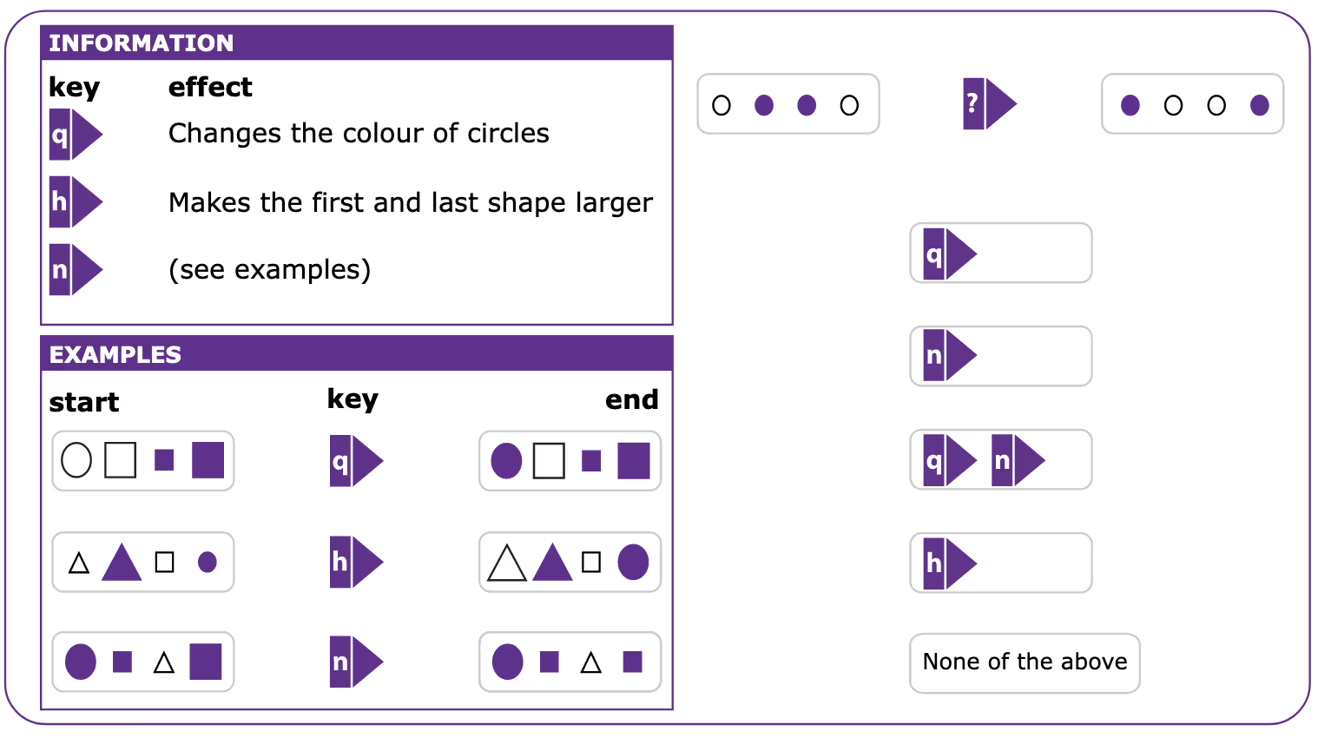
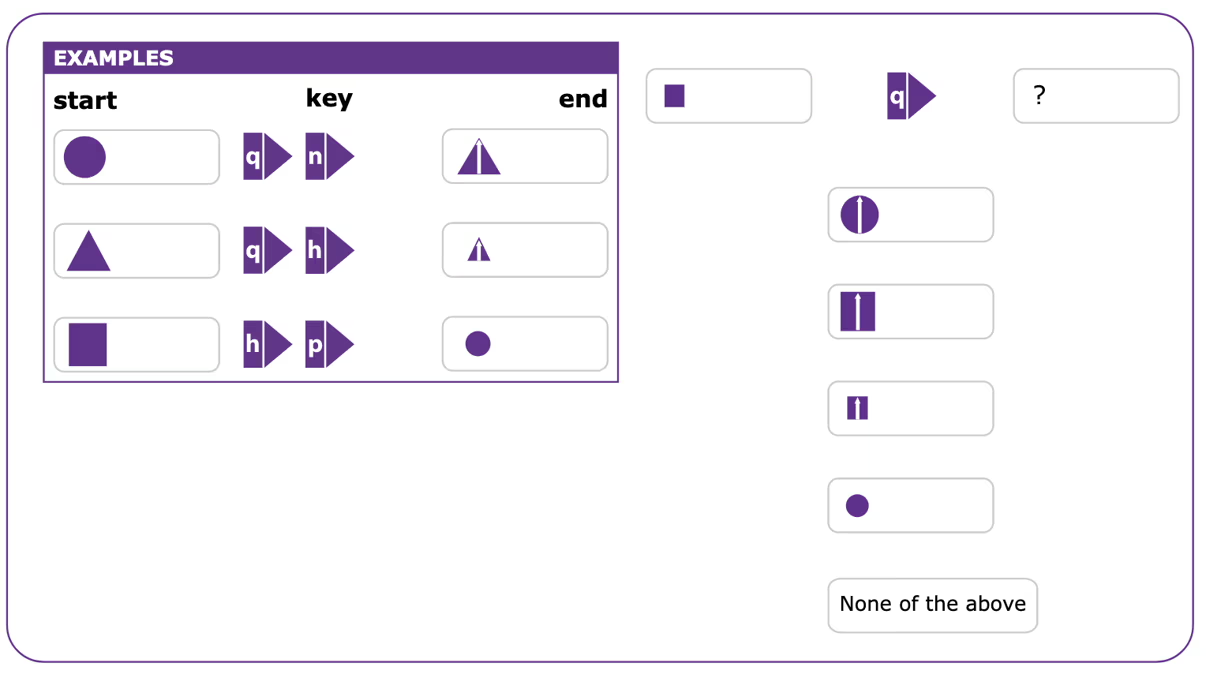
This type of test is also known as inductive reasoning. In this test, the candidate is presented with information in the form of a series of abstract symbols and diagrams. This information is necessary to solve the question and thus be able to provide the correct answer. It's all about discovering a pattern and logic in a sequence.
The inductive reasoning test is performed under a slight time constraint. The candidate is given 17 minutes to answer 25 questions. Naturally, the test is preceded by a detailed explanation.
Does practicing logical reasoning help?
Good logical reasoning is not an innate talent. It can be learned, and, with effort, we can also get better at it over time. A candidate who scores poorly on a logical reasoning test can therefore achieve a higher score in subsequent assessments by practicing logical reasoning. The candidate, therefore, benefits from ensuring proper preparation.
Prepare for the real tests
A candidate can prepare for the real assessment by working with abstract data where it is necessary to think logically. Extensive explanations can be found on the internet about preparing for tests in which logical reasoning is central.
Logical reasoning can be learned
In preparation for the real tests, for example, one can solve logic puzzles. Problems can also be solved that require analytical, logical reasoning, or spatial insight. Think, for example, of the systems in which a clear pattern can be found, such as within IT, biology, or chemistry. It is preferable to practice under a time constraint. Good preparation ensures that the candidate knows what to expect.
Testing logical reasoning is important
Being able to pass an analytical test that focuses on abstract, numerical, and verbal reasoning is an important predictor of a candidate's ability to understand the relationships between cause and effect. A candidate who excels in the test will also be able to apply those skills in the workplace in the form of problem-solving, negotiation, and estimation of cause and effect.
Assessments provide clarity
Cognitive assessments are now more important than ever. Finding staff is difficult for many companies and organizations. Analytical tests provide clarity.
Make better HR decisions
HR managers and recruiters who use logical reasoning tests can make better hiring decisions because they can better estimate candidates’ performance in advance.
Recruit talent, but also retain it
Top talents can be selected or retained and move on to positions within your organization where they can deliver the best performance. This ensures productivity but also helps to prevent high turnover.
Video: Cognitive Ability Test
A cognitive ability test measures the intelligence (IQ) of job applicants and employees. The Bridge Ability Suite is a widely used cognitive ability test for companies, organizations, and governments worldwide. The test is often used during recruitment or to assess whether an employee is ready for a next role or promotion.
You can take the test per candidate or use it through an affordable subscription, depending on your organization’s needs.






















-
What is a logical reasoning test?
-
A logical reasoning test measures how well someone can recognize patterns, analyze information, and draw correct conclusions. It is a practical way to assess problem solving and structured thinking in a work context.
-
What does a logical reasoning test measure exactly?
-
A logical reasoning test measures core cognitive ability skills, such as pattern recognition, deductive reasoning, inductive reasoning, and decision making under time pressure. Many employers use it as a short cognitive ability test to get a fast, objective signal of thinking level.
-
Is a logical reasoning test the same as an IQ test?
-
A logical reasoning test is often used as an IQ for adults in recruitment and selection. It focuses on reasoning and problem solving, which are key parts of general intelligence, but it is designed for workplace use and job related decisions.
-
Why do companies use a logical reasoning test in recruitment?
-
Companies use a logical reasoning test to predict job performance and learning speed, especially in roles where people must process information quickly and make sound judgments. It helps organizations reduce hiring risk with an objective measurement.
-
For which roles is a logical reasoning test most useful?
-
A logical reasoning test is commonly used for roles where drawing the right conclusions is essential, such as management, policy officer, analyst, lawyer, and journalist. It is also widely used for traineeships and graduate roles where learning agility matters.
-
Can a logical reasoning test be used for sales roles?
-
Yes. In a sales assessment, logical reasoning helps you see whether someone can analyze a customer situation, connect signals, and choose the best next step. It supports better judgment in complex sales cycles, negotiations, and account management.
-
What is a short cognitive ability test?
-
A short cognitive ability test is a compact assessment that measures cognitive ability in a limited time. It is designed to be efficient while still giving a reliable indication of reasoning level.
-
How long does a logical reasoning test take?
-
That depends on the specific assessment setup, but many logical reasoning tests are designed to be completed within a short time window. This makes them suitable for high volume recruitment and time efficient selection processes.
-
Is a logical reasoning test suitable for different education levels?
-
Yes. A logical reasoning test can be offered in levels that match the role complexity. It can be used for candidates at VET level, higher professional education level, and university education level, depending on what the position requires.
-
How do you interpret logical reasoning test results in hiring?
-
You interpret results by comparing the candidate’s score to the level required for the role and the organization’s benchmark. The score should be used alongside interviews and other assessment data, not as the only decision factor.
-
How do you prevent candidates from faking good results?
-
A well designed assessment process reduces gaming by using standardized conditions and robust scoring. TestGroup also offers assessments that combine multiple data points, for example cognitive ability together with personality and motivation.
-
Should you combine a logical reasoning test with a personality assessment?
-
Often, yes. Cognitive ability tells you how someone thinks, while personality helps you understand how someone behaves and collaborates. Many organizations combine a logical reasoning test with The Bridge Personality for a more complete profile.
-
Which TestGroup products can be combined with a logical reasoning test?
-
A logical reasoning test can be combined with The Bridge Ability Suite for broader cognitive ability measurement and with The Bridge Personality to add personality insights. For career direction and study choice, organizations also use The Bridge Career, depending on the target group and goal.
-
What is The Bridge Ability Suite?
-
The Bridge Ability Suite is TestGroup’s cognitive ability test solution used by companies and organizations to measure reasoning and thinking level. It supports recruitment, selection, and internal mobility decisions with clear, job relevant output.
-
How do you use a logical reasoning test in a selection procedure?
-
A common approach is: pre screen candidates with the logical reasoning test, shortlist based on role requirements, and then validate outcomes in interviews. For final candidates, organizations often add a personality assessment and a structured interview.
-
Is a logical reasoning test fair and objective?
-
A logical reasoning test is considered one of the most objective tools in selection because it measures performance on standardized tasks. Fairness improves further when you use clear job criteria, consistent administration, and multiple assessment methods.
-
Can we use a logical reasoning test for internal promotions?
-
Yes. Many organizations use a logical reasoning test to assess whether an employee is ready for a more complex role. It can support promotion decisions, talent programs, and succession planning.
-
What is the best way to explain a logical reasoning test to candidates?
-
Tell candidates it measures how they analyze information and solve problems, and that it is one part of a broader selection process. Emphasize that the test is standardized and job relevant.
-
How do I choose the right logical reasoning test for my organization?
-
Choose a test that matches your job level, is easy to administer, and provides clear reporting for decision makers. TestGroup can advise on the right setup, often combining the logical reasoning test with The Bridge Ability Suite and The Bridge Personality for a complete selection profile.
Online Assessment Tips