Detect socially desirable-answers with the Normative-Ipsative Split Technology® in The Bridge Personality
Products
Saturday 28 March 2026


What is socially-desirable answering behavior?
During selection procedures, many candidates will try to provide 'socially-desirable' answers when filling out a personality test. They will opt for statements that leave a favorable impression. For instance, they might choose the statement 'No one works as hard as I do' over 'I don't always help colleagues at work'. However, answering in this manner is unbeneficial. Organizations will recognize the dishonesty when they review the test report.
When completing a Big Five personality test, bear in mind that the test also includes items that assess the extent of socially-desirable answering. This is termed the social desirability scale. The items of this scale don't measure personality; they measure socially-desirable answering behavior.
An example is the statement, "No one works harder than I do." It's likely that this statement doesn't genuinely apply to anyone. If someone responds with "strongly agree," it may indicate socially-desirable answering.
This item doesn't genuinely apply to anyone. If someone answers 'strongly agree', it can be an indication of socially-desirable answering. Most personality tests indicate the extent of socially- desirable answers on a scale, typically ranging from one (not socially desirable) to ten (very socially- desirable). More advanced personality tests, like The Bridge Personality, go much beyond this. This test also provides a score on agreeable answering behavior and the consistency between normative and ipsative answers. These scales help determine the candidate's honesty, which is useful information during recruitment and selection with a personality test.
This technique is also available in the Competency Test, the 16 Personality Test and the 4-Color Personality Test.
Recognize socially-desirable answers in a personality test with Normative-Ipsative Split Technology®
The Bridge Personality uses a system that includes three main scales to understand how directive someone is when answering questions. It also uses Normative-Ipsative Split Technology®. This technology shows how strong someone's directive behavior is for different personality traits. For example, it can indicate if a person is honest about their attention to detail but not as truthful about their focus on results. This information is helpful during the selection process.
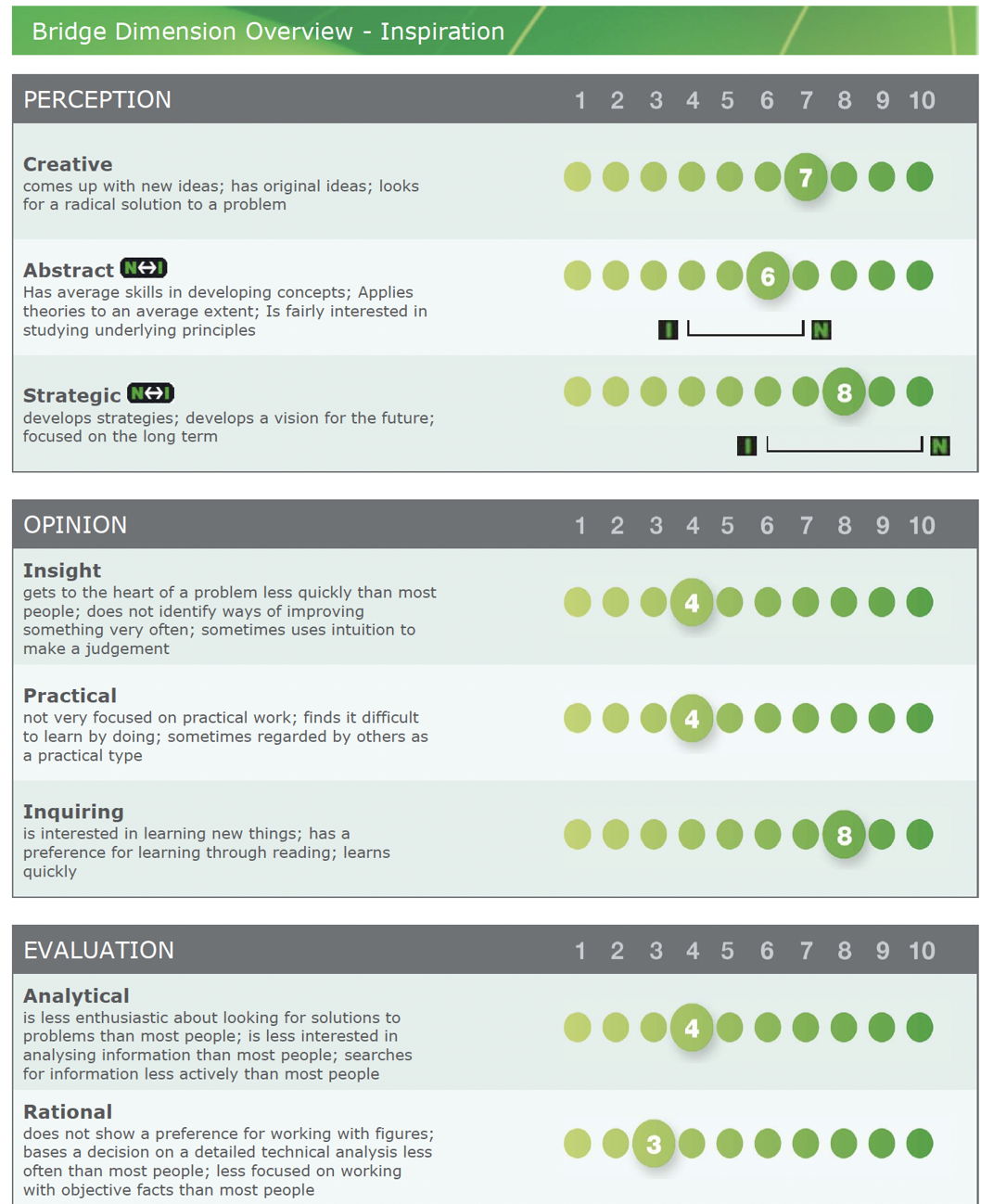
If a candidate has difficulty choosing among statements related to a specific dimension, a normative-ipsative split will appear in the report next to that dimension. The 'N' (for normative) is positioned beneath the normative score, while the 'I' (for ipsative) is placed below the ipsative score. This dimension reflects the candidate's challenges in decision-making. It's intriguing to explore the reasons behind this. Several factors could be involved (such as the explanations provided earlier). The feedback provider and the candidate should discuss this together. A normative-ipsative split isn't negative; it simply offers additional insights.
Example of a Normative-Normative-Ipsative Split
In the below example page of The Bridge Personality report, there is a normative-ipsative split at the competency: Abstract. Here the normative score is 7, where the ipsative score is 4. Hence, the split appears in the report, representing a certain doubt that the participant had while completing the questionnaire. This doubt can either be intentional faking (this may occur with job applicants in recruitment procedures), or it may represent a doubt that the participant has on the specific competency (Abstract). For example, the normative score (N) may represent the behavior in social environments (at home) and the ipsative (I) represents the behavior at work. Of course, there can be many other reasons why a participant displays a certain amount of doubt on a competency. The normative-ipsative will help you to recognize the doubt and discuss it with the participant.
Detecting and Reducing Faking in Personality Assessment
Faking, or socially desirable answering, remains a persistent challenge in personality assessments, especially in high-stakes settings such as recruitment and selection. The recent review by Dunlop et al (2025) highlights that candidates often present themselves in an overly favorable way, which can distort personality scores and reduce the accuracy of interpretations. At the same time, the research shows that while faking can lower validity, personality assessments still retain meaningful predictive value. This makes it essential not only to measure personality, but to actively detect and control for response distortion. Traditional single-stimulus questionnaires are particularly vulnerable, as they allow respondents to consistently choose the most socially desirable answers without constraint.
To address this, modern psychometric approaches increasingly rely on forced-choice and ipsative techniques, which require respondents to choose between equally desirable options. These formats reduce the opportunity to “fake good” by introducing trade-offs, making it harder to maintain a consistently inflated self-image. The normative-ipsative split in The Bridge Personality builds directly on these insights by combining normative measurement (comparison to a reference group) with ipsative forced-choice elements. This dual approach not only limits socially desirable responding, but also makes it possible to detect inconsistencies between how candidates present themselves and how they prioritize traits. In line with the findings from the article, this combination offers a practical and scientifically grounded way to improve both the reliability and interpretability of personality assessments in real-world selection contexts.
Do you want more information about The Bridge Personality?
Interested in learning more about The Bridge Personality, the personality test from TestGroup? Contact us here.
Order The Bridge Personality personality test
You can order The Bridge Personality personality test for your candidate or employee on the TestGroup order page.
Video: administer The Bridge Personality with a corporate account.
With a corporate account on The Bridge Assessment Platform, you can send invites to candidates, manage online assessments and get reports anytime, anywhere globally. Companies, government bodies, psychologists, hiring professionals, and coaches across more than 20 countries use The Bridge Assessment platform. It's user-friendly, meaning lengthy training isn't necessary. Plus, you can jump right in; your account will be set up in a
day.






















-
What is socially desirable answering in personality tests?
-
Socially desirable answering occurs when candidates present themselves in a more favorable way than they truly are. This often happens in recruitment or assessment settings where there is pressure to perform well. As a result, personality scores can become less accurate and harder to interpret.
-
Why is socially desirable answering a problem for organizations?
-
When candidates give socially desirable answers, it becomes more difficult to identify their true strengths, risks, and development areas. This can lead to mismatches in hiring and less effective development decisions. Reducing this bias is essential for reliable assessments.
-
How does The Bridge Personality reduce socially desirable answers?
-
The Bridge Personality uses a normative-ipsative split. This means it combines traditional rating questions with forced-choice questions. Candidates must choose between equally desirable traits, making it harder to consistently give socially preferred answers. This leads to more honest and realistic results.
-
What is the difference between normative and ipsative measurement?
-
Normative measurement compares a candidate’s scores to a reference group. Ipsative measurement forces trade-offs between traits, revealing personal preferences and priorities. By combining both, The Bridge Personality increases reliability and detects inconsistencies in responses.
-
Can you detect if a candidate is faking answers?
-
Yes, the combination of normative and ipsative scores provides insight into inconsistencies. Large differences between these scores can indicate hesitation or impression management, allowing for better interpretation of results.
-
Why is this approach more reliable than traditional personality tests?
-
Traditional personality questionnaires rely mainly on self-report scales, which are easier to manipulate. The normative-ipsative split adds an extra layer of control, reducing response bias and improving the overall accuracy of the assessment.
-
Is The Bridge Personality a good alternative to DISC or Insights Discovery?
-
Yes, The Bridge Personality is a strong alternative to DISC and Insights Discovery. While those models focus mainly on simplified behavioral styles, The Bridge Personality combines the Big Five, 16 Jung Types and the 4-color model in one assessment. In addition, the normative-ipsative split makes it more robust against socially desirable answering, resulting in more reliable and actionable insights for selection and development.
-
How can organizations use these insights in practice?
-
Organizations use The Bridge Personality to improve hiring decisions, identify development needs, and build stronger teams. By reducing socially desirable answering, the results provide a more accurate foundation for interviews, coaching, and talent management.
-
What does the article “Detecting and Reducing Faking in Personality Assessment” (Dunlop et al., 2025) explain and how does The Bridge Personality apply this?
-
The article shows that faking is common in high-stakes situations like recruitment, where candidates present themselves more positively, which can distort personality scores. At the same time, it confirms that personality tests still have predictive value, making it essential to detect and reduce response bias. The Bridge Personality directly applies these insights through its normative-ipsative split, combining traditional questions with forced-choice items. This makes it harder to give socially desirable answers and reveals inconsistencies, resulting in more reliable and actionable outcomes.
-
Is The Bridge Personality a good alternative to MBTI or DISC?
-
Yes, The Bridge Personality is a strong alternative to MBTI and DISC. While these models are more sensitive to socially desirable answering, The Bridge Personality uses the normative-ipsative split to reduce this bias. In addition, it combines multiple frameworks such as Big Five, 16 Jung Types and the 4-color model, providing more depth and more reliable insights for selection and development.
Online Assessment Tips